

If you're taking a statin and your legs feel heavy, your muscles ache after walking, or you're too tired to climb stairs, you're not alone. About 1 in 5 people on statins experience muscle pain-some mild, some bad enough to quit the medicine altogether. And if you've searched online for relief, you've probably seen ads pushing Coenzyme Q10 (CoQ10) as the fix. But does it actually work? Or is it just another supplement promise that sounds good but doesn’t deliver?
Why Statins Might Be Causing Your Muscle Pain
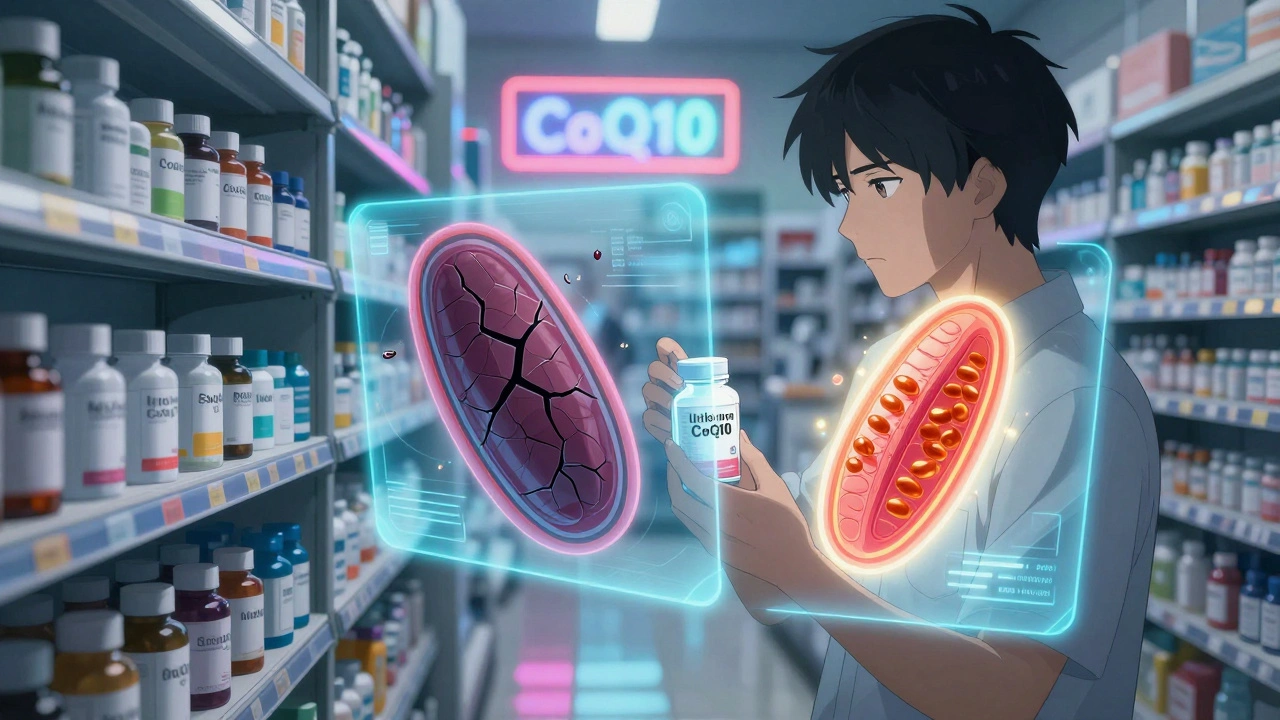
Statins lower cholesterol by blocking an enzyme called HMG-CoA reductase. That’s their job. But that same enzyme is also needed to make CoQ10, a compound your body uses to produce energy in your muscles. When statins cut down on CoQ10, your muscles might not get enough fuel. That’s the theory anyway. Studies show statins can drop CoQ10 levels in your blood by up to 54%. That sounds alarming. But here’s the twist: some studies found no drop in muscle tissue CoQ10-even in people with muscle pain. So the connection isn’t as simple as "statins = less CoQ10 = pain." Still, the idea stuck because it makes sense biologically. And when people feel better after taking CoQ10, it feels like proof.What the Research Actually Shows
There’s no single answer. Some studies say yes, CoQ10 helps. Others say no. And a few say it depends on who you are. A 2018 meta-analysis in the Journal of the American Heart Association looked at 12 trials with nearly 600 people. It found that CoQ10 reduced muscle pain by about 1.6 points on a 10-point scale, muscle weakness by 1.75 points, and fatigue by the same amount. Those numbers might not sound like much, but for someone who can’t walk their dog without pain, it’s meaningful. But then there’s the 2007 study by Young and colleagues. They gave 200 mg of CoQ10 daily to statin users for 12 weeks. Plasma CoQ10 levels went up-but muscle pain didn’t improve. Same dose. Different result. Why the contradiction? It might be because not all CoQ10 is the same. There are two forms: ubiquinone and ubiquinol. Ubiquinol is the active, absorbed version. Many supplements still sell ubiquinone, which your body has to convert. That conversion slows down with age and illness. So if you’re taking the wrong form, you might not get any benefit.Who Might Actually Benefit
Not everyone responds. But if you fit this profile, CoQ10 might help:- You have mild-to-moderate muscle aches-not full-blown weakness or dark urine (signs of serious muscle damage).
- You’ve tried switching statins and still have pain.
- You’re not taking a high dose (like 80 mg of atorvastatin).
- You’ve been on statins for more than 3 months.
What Dose Should You Take?
There’s no official guideline. But based on the trials that worked:- Start with 100-200 mg per day.
- Choose ubiquinol, not ubiquinone. It’s better absorbed.
- Take it with food-especially something fatty. CoQ10 is fat-soluble. No fat, no absorption.
- Give it at least 6-8 weeks before deciding if it’s working.
What It Won’t Do
CoQ10 won’t fix everything.- It won’t help if your pain is from nerve damage, arthritis, or vitamin D deficiency.
- It won’t prevent rhabdomyolysis-the rare, dangerous muscle breakdown that can lead to kidney failure.
- It won’t lower your cholesterol. It doesn’t replace your statin.
Real People, Real Results
Online, the story is mixed. On Reddit, 78% of 142 people said CoQ10 eased their pain. One user wrote: "After 6 months of leg cramps on atorvastatin, 200 mg of CoQ10 killed the pain in 3 weeks. I’m still on my statin. No more night cramps." But on Drugs.com, someone named MaryT wrote: "Tried three brands. 200 mg for four months. Zero change." That’s the reality. About 60-70% of users report some benefit. Only 30-40% say it’s a game-changer. The rest? Nothing.Cost, Safety, and Accessibility
CoQ10 is cheap. A month’s supply of 200 mg ubiquinol costs $15-$40. Compare that to switching statins-some cost $300-$600 a month under insurance. CoQ10 is a low-risk, low-cost experiment. Safety? Excellent. No serious side effects reported in 40 years of use. Even at 600 mg/day, most people feel nothing but possibly a slight stomach upset. No liver damage. No interactions with blood thinners. No known overdose. It’s sold over the counter. No prescription needed. You can buy it at Target, Walmart, or Amazon. Look for brands that are third-party tested-USP, NSF, or ConsumerLab certified. Avoid the ones with "proprietary blends" or no dosage listed.
What Doctors Really Think
Most cardiologists aren’t sold on CoQ10 as a cure. The American College of Cardiology says evidence is "inconclusive." But they also say it’s "reasonable to try" if you’re at risk of quitting your statin. That’s the key. Statins save lives. They prevent heart attacks and strokes. But if you stop taking them because of muscle pain, your risk goes up. CoQ10 might help you stay on your statin. That’s the real win. Mayo Clinic, Cleveland Clinic, and other top hospitals include CoQ10 in their statin intolerance protocols-not as a first step, but as a trial option after other tweaks fail.What to Do Next
If you’re on a statin and having muscle pain:- Don’t stop your statin without talking to your doctor.
- Ask if your pain could be from something else-vitamin D, thyroid issues, or overuse.
- If it’s likely statin-related, try 100-200 mg of ubiquinol daily with dinner.
- Wait 6-8 weeks. Keep a pain journal: rate pain on a scale of 1-10 each day.
- If no change after two months, stop it. It’s not helping.
- If you feel better, keep taking it. There’s no harm in continuing.
Final Thoughts
CoQ10 isn’t magic. It’s not proven in every study. But it’s safe, cheap, and might help you stay on your statin. For people who’ve tried everything else and still have pain, it’s worth a shot. The science isn’t settled. But the stakes are high. Statins prevent heart disease. CoQ10 might help you keep taking them. And that’s more important than whether a study calls it "significant."Can CoQ10 replace my statin?
No. CoQ10 does not lower cholesterol or reduce heart attack risk. It’s only a supplement that may help with muscle pain caused by statins. Never stop your statin without talking to your doctor.
How long does it take for CoQ10 to work for muscle pain?
Most people who respond see improvement after 4-8 weeks. Some take up to 12 weeks. Don’t give up after two weeks. Muscle pain from statins builds up slowly, and so does the relief.
Is ubiquinol better than ubiquinone for statin users?
Yes. Ubiquinol is the active form of CoQ10 and is better absorbed, especially in older adults or those with health conditions. Ubiquinone must be converted by your body, which becomes less efficient with age. For statin users, ubiquinol is the better choice.
Can I take CoQ10 with other supplements like vitamin D or magnesium?
Yes. Many people on statins also have low vitamin D, which can cause muscle pain. Taking vitamin D and magnesium alongside CoQ10 is common and safe. Just avoid mega-doses of any supplement without medical advice.
Will CoQ10 cause weight gain or affect my sleep?
No. There’s no evidence CoQ10 causes weight gain, insomnia, or changes in sleep patterns. The most common side effect, if any, is mild stomach upset-usually only at very high doses (over 300 mg).
Should I get my CoQ10 levels tested before starting?
Not usually. Blood tests for CoQ10 are not standardized, expensive, and not covered by insurance. Most doctors won’t order them. The best approach is a trial: take it for 8 weeks and see if your symptoms improve.
Is there a chance CoQ10 could make my muscle pain worse?
Extremely unlikely. There are no documented cases of CoQ10 worsening muscle pain. If your pain gets worse after starting CoQ10, it’s probably unrelated. Consider other causes like overexertion, dehydration, or another medication.
Releted Post


Caspian Fothergill
Hello, my name is Caspian Fothergill. I am a pharmaceutical expert with years of experience in the industry. My passion for understanding the intricacies of medication and their effects on various diseases has led me to write extensively on the subject. I strive to help people better understand their medications and how they work to improve overall health. Sharing my knowledge and expertise through writing allows me to make a positive impact on the lives of others.
Hey, if you're on statins and dealing with muscle pain, CoQ10 is worth a shot-especially if you’ve tried everything else. I’ve seen friends go from barely walking the dog to biking again after 6 weeks of 200mg ubiquinol with dinner. No magic, but no downsides either. Just give it time.
I tried it. Didn’t do squat. Still can’t climb stairs. Maybe it works for some, but I’m done wasting money on supplements that sound like ads.
Of course it 'works'-for the supplement industry. Big Pharma doesn't want you to know CoQ10 is cheap and natural. They profit off statins. The 'studies' are funded by labs that sell CoQ10. Look at the conflict of interest. You're being manipulated.
Neelam, the studies aren't all funded by supplement companies. The 2018 meta-analysis was peer-reviewed and included trials from public universities. Also, ubiquinol absorption is real-your body converts ubiquinone less efficiently after 40. That’s biochemistry, not conspiracy. If you’re skeptical, fine. But don’t dismiss what’s been tested.
CoQ10 is a Trojan horse. The FDA knows it works. They suppress the data because statins are more profitable. The 2007 Young study? Buried. The 2014 study showing 75% improvement? Ignored. The pharmaceutical lobby controls every medical journal. You think your doctor really wants you to feel better? Or just keep taking pills?
OMG I CAN’T BELIEVE YOU’RE ALL JUST ACCEPTING THIS AS IF IT’S SCIENCE???! I took CoQ10 for 6 months and my legs turned to JELLO. Then I found out my statin was expired! It wasn’t the CoQ10-it was the BAD BATCH! THEY’RE DOING THIS ON PURPOSE TO MAKE US BLAME SUPPLEMENTS!!
The data is messy, but the practical takeaway is clear: if you’re experiencing mild statin-related muscle discomfort, and you’ve ruled out other causes, CoQ10-specifically ubiquinol-is a low-risk, low-cost intervention with a reasonable chance of helping. It’s not a cure-all, but it’s not nonsense either. The medical community’s hesitation reflects scientific caution, not dismissal. For many, it’s the difference between staying on a life-saving medication or quitting it.
Ha! You Americans think a $20 supplement fixes everything. In India, we know real medicine: exercise, diet, and no statins unless absolutely necessary. CoQ10? A Western placebo for lazy people who won’t walk 30 minutes a day. Your muscles ache because you sit all day and eat processed junk. Stop blaming pills-and start moving.