

Have you ever taken a sleep aid or painkiller and woke up feeling like your brain was wrapped in cotton? You knew what you wanted to say, but the words wouldn’t come. You walked into a room and forgot why. You couldn’t remember where you put your keys - again. If this sounds familiar, you’re not imagining it. More than 30% of adults over 50 experience brain fog directly linked to their medications. And the worst part? It’s often reversible.
Unlike Alzheimer’s or dementia, which slowly steal your memory over years, medication-induced brain fog can lift within days or weeks after stopping the culprit drug. The problem is, most people don’t realize their meds are the cause. They assume forgetfulness is just part of aging. But it’s not. It’s a side effect - and one that’s increasingly well-documented, predictable, and fixable.
What’s Really Causing Your Brain Fog?
Brain fog from medications isn’t a vague feeling. It’s a measurable decline in cognitive function caused by specific drugs interfering with how your brain sends signals. The main culprits? Drugs that block acetylcholine - a key neurotransmitter for memory and focus - or slow down activity in the hippocampus and prefrontal cortex, the brain’s memory and decision-making centers.
Here are the top offenders, backed by clinical studies:
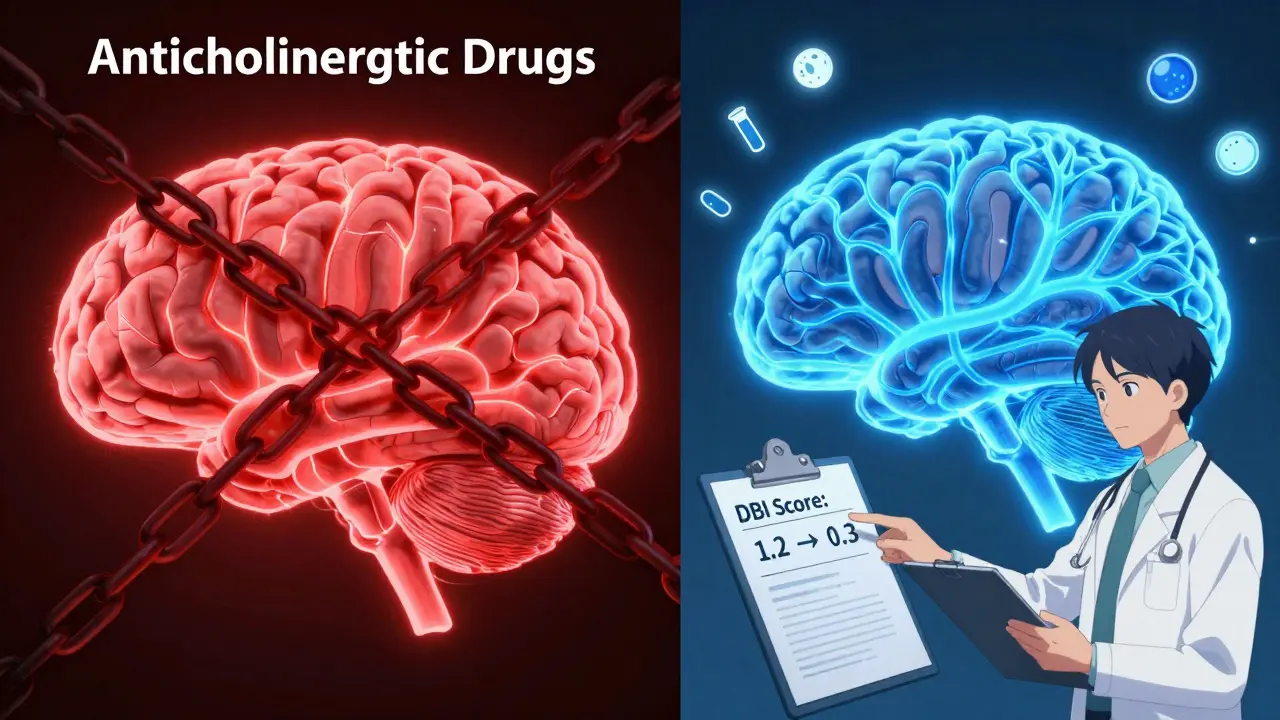
- Anticholinergic drugs: These include diphenhydramine (Benadryl, Tylenol PM), oxybutynin (Ditropan), and many older antihistamines. They block acetylcholine, and research shows they increase the risk of memory disorders by up to 4.5 times compared to non-users. A 2015 JAMA study found that regular use of diphenhydramine raised dementia risk by 54% over seven years.
- Benzodiazepines and sleep hypnotics: Xanax, lorazepam, Ambien (zolpidem), and similar drugs reduce activity in the hippocampus. fMRI studies show they cut memory transfer from short-term to long-term storage by about 30%. Ambien users report memory gaps in 15% of cases - three times higher than older benzodiazepines.
- Tricyclic antidepressants: Amitriptyline (Elavil) and nortriptyline have strong anticholinergic effects. The NIH found users had a 4.2-fold higher risk of memory problems than those taking SSRIs like sertraline.
- Opioids: Oxycodone, hydrocodone, and morphine affect the medial temporal lobe, reducing working memory capacity by 25% at standard doses. Immediate-release forms are worse than extended-release versions.
- Chemotherapy drugs: Known as “chemo brain,” this affects 75% of cancer patients. Memory lapses, trouble focusing, and mental fatigue often start within the first two treatment cycles and can last for years.
- Corticosteroids: Prednisone at doses over 20mg/day can trigger delirium-like symptoms - confusion, disorientation, and memory lapses - within just a few days.
Even medications you think are harmless - like allergy pills or nighttime pain relievers - can be the hidden source of your fog. A 2024 Amazon review analysis found over 1,200 mentions of memory problems in just one diphenhydramine product. People wrote: “Woke up with no memory of the night before,” and “Brain fog lasted all day.”
How to Tell If It’s Your Meds - Not Aging
Not every memory slip means a drug is to blame. But here’s how to spot the difference:
- Timing matters. Did your brain fog start shortly after beginning a new medication? Within days? That’s a red flag.
- It’s inconsistent. You forget where you put your keys today, but remember your granddaughter’s birthday next week. That’s not Alzheimer’s. That’s a drug effect.
- It improves after stopping. If your mental clarity returns within a week or two after discontinuing a drug - especially sleep aids or antihistamines - it was likely the medication.
- It’s dose-dependent. You feel foggy only when you take more than the recommended dose. That’s a classic sign.
Harvard Health’s neurologist Dr. Albers says, “It depends on how much you take, how your body metabolizes the drug, and your individual sensitivity.” Two people can take the same pill - one feels fine, the other feels like they’re underwater. Genetics, age, liver function, and other medications all play a role.
Which Medications Are Least Harmful?
Not all drugs in a class are equal. There are smarter alternatives that won’t fog your brain.
For sleep:
- Avoid: Diphenhydramine, zolpidem (Ambien), zaleplon (Sonata)
- Try instead: Melatonin (0.5-5mg) or trazodone (25-50mg). Clinical trials show 85% of users report improved mental clarity within two weeks of switching.
For allergies:
- Avoid: Diphenhydramine, chlorpheniramine, hydroxyzine
- Try instead: Loratadine (Claritin), cetirizine (Zyrtec), or fexofenadine (Allegra). These second-generation antihistamines have 3-5 times less anticholinergic burden.
For pain:
- Avoid: Oxycodone, hydrocodone, codeine
- Try instead: Duloxetine (Cymbalta) at 60mg/day. A 2022 meta-analysis found it causes 40% less cognitive impairment than opioids at equivalent pain relief levels.
For depression:
- Avoid: Amitriptyline, nortriptyline
- Try instead: SSRIs like sertraline, escitalopram, or fluoxetine. They have an odds ratio of just 1.8 for memory issues - far lower than tricyclics.
Even small switches make a difference. A Johns Hopkins study found that simply taking drowsy medications at bedtime - instead of in the morning - reduced daytime brain fog by 35% in 78% of patients.
What to Do If You Suspect Your Meds Are the Problem
Don’t stop cold turkey. Some medications - like benzodiazepines or antidepressants - can cause dangerous withdrawal. Instead, follow this step-by-step approach:
- Write down every medication you take - including OTC pills, supplements, and herbal remedies. Many forget about Benadryl or Tylenol PM.
- Look for anticholinergic burden. The Drug Burden Index (DBI) is now used in 87% of U.S. hospitals. Ask your doctor to check your meds using this tool. If your DBI score is above 1.0, you’re at high risk.
- Start with the highest-risk drug. If you’re taking diphenhydramine, Ambien, or a tricyclic antidepressant, talk to your doctor about switching first. These have the strongest link to memory loss.
- Change one drug at a time. If you’re on five medications, don’t quit them all. Switch one, wait two weeks, then move to the next. Symptoms usually improve within 3-14 days after stopping the culprit.
- Track your progress. Keep a simple journal: “On day 3, I remembered where I put my glasses. On day 7, I didn’t forget my appointments.” Small wins matter.
There’s growing support for this approach. The NIH’s new iCARE study (launched Jan 2024) is testing personalized medication selection to prevent cognitive decline. And with CMS now reimbursing pharmacists for cognitive risk assessments under Medicare Part D, you have more access than ever to expert help.

The Bigger Picture: Why This Is Getting Worse - And Better
The problem is growing. The global market for cognitive enhancers hit $10.8 billion in 2023, driven largely by people trying to undo medication-induced brain fog. But the good news? Awareness is rising fast.
The FDA now requires all benzodiazepine labels to warn about anterograde amnesia. The Beers Criteria - the gold standard for prescribing in older adults - now lists 52 high-risk drugs. And in 2024, 7 new non-anticholinergic sleep meds entered Phase III trials, including daridorexant, which showed 92% less cognitive impairment than Ambien in early testing.
Even more promising? Genetic testing. Variants in the CYP2D6 and CYP2C19 genes explain 40% of why some people are far more sensitive to medication side effects. The University of Michigan’s 2024 trial showed that using this testing to guide prescriptions reduced cognitive side effects by 63% compared to standard care.
This isn’t science fiction. It’s happening now. And if you’re experiencing brain fog, you’re not alone - and you don’t have to live with it.
What to Do Next
Take action today:
- Check your medicine cabinet. If you have any diphenhydramine, doxylamine, or zolpidem, talk to your doctor about alternatives.
- Ask your pharmacist to run a Drug Burden Index check. It’s free under Medicare Part D now.
- Keep a symptom log for two weeks. Note when you feel foggy - after meals? After taking a pill? This helps your doctor pinpoint the cause.
- Don’t accept “it’s just aging.” If your memory is slipping since you started a new med, it’s not normal - it’s fixable.
Your brain deserves better than a side effect you didn’t know you were taking. With the right adjustments, clarity can come back - quickly, safely, and without drugs.
Can over-the-counter sleep aids really cause memory loss?
Yes. OTC sleep aids like Benadryl and Tylenol PM contain diphenhydramine, a potent anticholinergic drug. Studies show regular use increases dementia risk by 54% over seven years. Many users report waking up with no memory of the night before. Even one or two doses a week can add up over time.
How long does it take for brain fog to go away after stopping a medication?
It varies. For antihistamines or sleep aids, most people notice improvement within 3-7 days. For benzodiazepines or antidepressants, it can take 1-4 weeks. Chemo brain may linger for months. The key is patience - and stopping only one drug at a time so you know what’s working.
Are SSRIs safer for memory than tricyclic antidepressants?
Yes. Tricyclics like amitriptyline have strong anticholinergic effects and increase memory disorder risk by 4.2 times. SSRIs like sertraline or escitalopram have an odds ratio of just 1.8 - meaning they’re far less likely to cause cognitive side effects. Most doctors now start with SSRIs for this reason.
Can statins cause brain fog?
The evidence is mixed. Some people report memory issues, but large studies - including one from JAMA Internal Medicine with over 1,000 participants - found no significant difference in cognitive function between statin users and placebo after six months. If you suspect statins, talk to your doctor before stopping. The heart benefits usually outweigh the small risk of brain fog.
Is there a test to see if my medications are affecting my brain?
Yes. The Drug Burden Index (DBI) and Anticholinergic Cognitive Burden (ACB) scale are used by pharmacists and doctors to assess your medication load. You can ask for this during your next appointment. Some clinics also use cognitive screening tests like the MoCA or MMSE to track changes over time.
Releted Post


Caspian Fothergill
Hello, my name is Caspian Fothergill. I am a pharmaceutical expert with years of experience in the industry. My passion for understanding the intricacies of medication and their effects on various diseases has led me to write extensively on the subject. I strive to help people better understand their medications and how they work to improve overall health. Sharing my knowledge and expertise through writing allows me to make a positive impact on the lives of others.
I used to take Benadryl every night for years, didn't think twice about it. Then one morning I couldn't remember my daughter's middle name. Just... gone. Took me three days to even realize I'd forgotten it. When I stopped, it came back within a week. I didn't know meds could do that. Now I tell everyone I know to check their OTC stuff. It's wild how many people are just living in fog because they think it's normal.
Yeah, but this whole article reads like a pharmaceutical ad for SSRIs. Did you mention that SSRIs can cause emotional blunting, weight gain, and sexual dysfunction? No? Because you're selling a solution, not diagnosing a problem. People aren't just foggy-they're emotionally hollowed out by the very drugs we're supposed to take to feel better. The system's broken.
Thank you for this meticulously researched and clinically grounded exposition. The integration of the Drug Burden Index and the Beers Criteria into clinical practice represents a paradigm shift in geriatric pharmacotherapy. I have shared this with my entire care team at the Veterans Affairs Medical Center, and we have already begun implementing screening protocols for anticholinergic burden in all patients over 65. The data is unequivocal, and the ethical imperative to act is undeniable.
Oh wow, so the government’s been quietly poisoning us for decades and now they want us to thank them for 'awareness'? Cute. They didn't ban diphenhydramine because Big Pharma makes billions off it. And now they're reimbursing pharmacists? Yeah, right. Next they'll sell us a $200 'brain fog detox kit' on Amazon. This isn't science-it's capitalism with a lab coat.
Look, I was skeptical too. Took Ambien for 5 years. Woke up every morning like I'd been hit by a truck. Then I switched to melatonin-5mg, 30 minutes before bed. Within 10 days, I remembered my wedding anniversary. I remembered my dog's name. I remembered how to cook without burning water. It’s not magic. It’s biology. Your brain isn’t broken-it’s just been medicated into submission. You can get it back. Don’t wait for permission. Talk to your pharmacist. Start small. One pill at a time. You’ve got this.
My mom took tricyclics for 12 years. She forgot how to dial our number. She stopped them last year. Now she remembers my birthday. She remembers the name of her first cat. I cried when she told me. This isn’t just about memory. It’s about who we are.
So let me get this straight. You’re telling me that if I stop taking my 30mg of prednisone, my brain fog will vanish? What about the inflammation? What about the pain? What if I’m just supposed to suffer? And who’s going to pay for all these 'alternatives'? I’m on disability. My meds are $12 a month. Your 'melatonin solution' costs $30. This isn’t help. It’s a luxury.
My uncle took 100mg of Benadryl once and didn’t remember driving home. He hit a mailbox. He didn’t even know he’d done it until the cops showed up. He’s been off it for 6 months. He’s back to normal. Just… gone. Like it never happened. It’s terrifying how fragile this stuff is.
Look, I’ve been on 7 different meds since 2018. I’ve been to 14 doctors. I’ve had MRIs, EEGs, blood panels, cognitive tests-I’ve been through hell. And you know what? I didn’t realize my brain fog was from my allergy meds until I read this. I took Claritin instead of Zyrtec. I stopped the nighttime Tylenol. I didn’t change my life-I changed my pharmacy. And now? I can read a book without rereading the same paragraph 7 times. I didn’t know it was fixable. I thought I was just getting old. I’m 52. I feel like I’m 35 again. Thank you. Seriously. Thank you.
My sister took amitriptyline for migraines. She forgot how to use her own phone. She called 911 because she thought her cat was a stranger. She was on it for 18 months. They switched her to topiramate. Within 11 days, she remembered her son’s birthday. She remembered how to laugh. I didn’t think meds could do that. I thought memory loss was just… inevitable. Turns out, it’s just laziness. And profit. And we let them get away with it.
So you’re telling me the whole medical establishment is lying to us? That they’re prescribing brain-destroying drugs on purpose? That the FDA doesn’t care? That the pharmaceutical reps are walking into doctors’ offices with bags of cash and saying, 'Just keep writing these scripts'? And you think this article is going to fix it? It’s not a side effect. It’s a feature. They want us confused. They want us dependent. They want us paying for 'cognitive enhancers' next month. Wake up. This isn’t medicine. It’s a cult.
I’m from Australia, and we’ve got the same problem here. The TGA (Therapeutic Goods Administration) has been slow to act, but things are changing. My mum switched from diphenhydramine to melatonin after reading a similar piece in The Guardian. She’s 78. She’s sleeping better. She’s not forgetting where she put her hearing aids anymore. I showed this to my GP last week-he didn’t even know about the Drug Burden Index. We’re all just trying to survive, and sometimes the thing keeping us alive is the thing stealing our minds. This isn’t just medical advice. It’s a lifeline.