
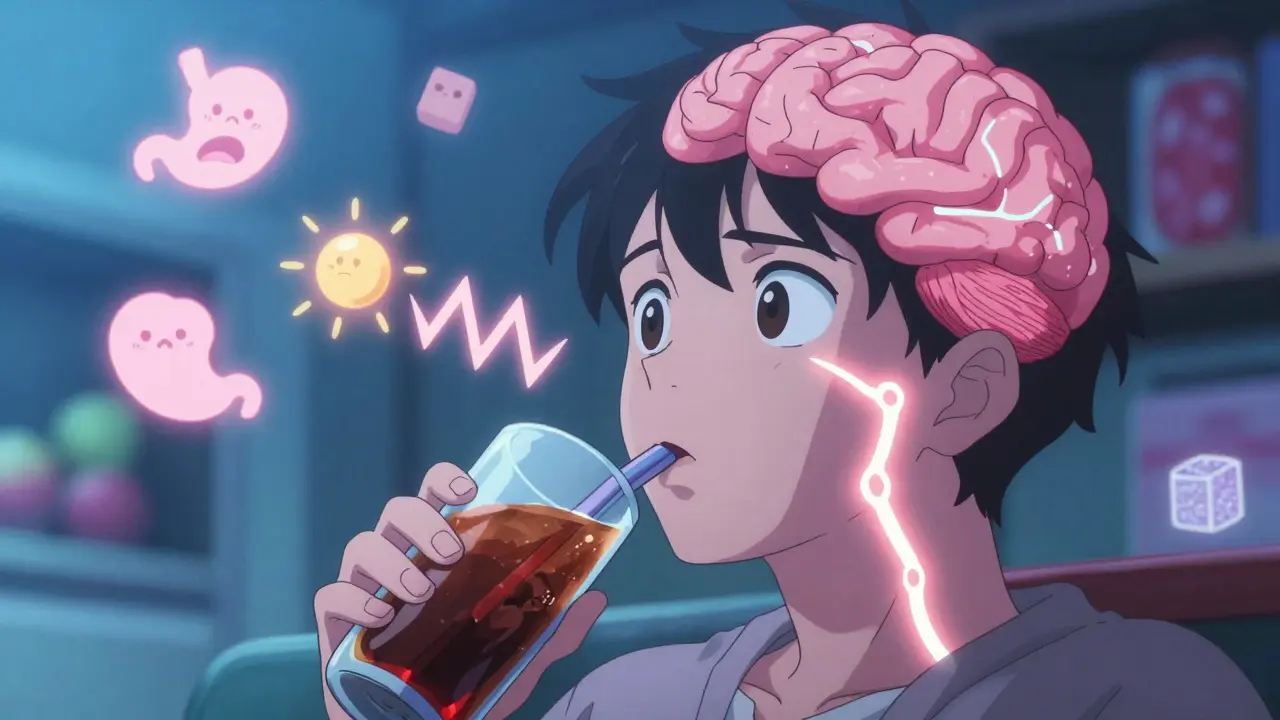
When you swap sugar for artificial sweeteners hoping to cut calories and control cravings, you might expect a simple win. But the truth? Your brain doesn’t always play along. Some people feel less hungry. Others feel hungrier than before. And it’s not just about willpower-it’s biology.
What happens when you drink a diet soda?
You take a sip of a zero-calorie soda. Your tongue registers sweetness. Your brain expects energy. But no calories arrive. That mismatch triggers a chain reaction. A 2023 study from the University of Southern California found that sucralose-the sweetener in Splenda-doesn’t trigger the release of GLP-1, a hormone that tells your brain you’re full. Without that signal, hunger sticks around. In people with obesity, that meant a 17% spike in subjective hunger after just one drink.Why sugar feels different
Sugar isn’t just sweet-it’s fuel. When you eat it, your body releases insulin, lowers blood glucose, and signals satiety. A 2021 study from the German Center for Diabetes Research showed sugar raises blood glucose levels by nearly 7 times more than sucralose. That spike and drop can leave you crashing later, but at least your body knows what to do with it. Artificial sweeteners? They’re silent. No insulin spike. No energy delivery. Just sweetness with no payoff.The brain’s reward system gets confused
Your brain links sweetness with calories. That’s how evolution wired it. When you eat something sweet, you get energy. That’s a survival cue. But when you drink a diet soda every day, your brain starts to notice: sweet ≠ calories. Over time, it recalibrates. A 2016 study from the University of Sydney found fruit flies exposed to sucralose for five days ate 30% more when given real sugar later. The same thing happens in humans. The more you rely on artificial sweetness, the more your brain craves intense sweetness to feel satisfied.Sex matters more than you think
Women respond differently to artificial sweeteners than men. The same 2023 USC study used fMRI scans and found that sucralose changed brain activity in the hypothalamus and anterior cingulate cortex by 23% in women, compared to just 12% in men. That’s a 40% greater neural response. It might explain why more women report increased cravings after switching to diet products. Hormonal differences, brain wiring, and even gut microbiome variations could be at play. If you’re a woman and you’ve noticed your cravings worsening with diet sodas, you’re not imagining it.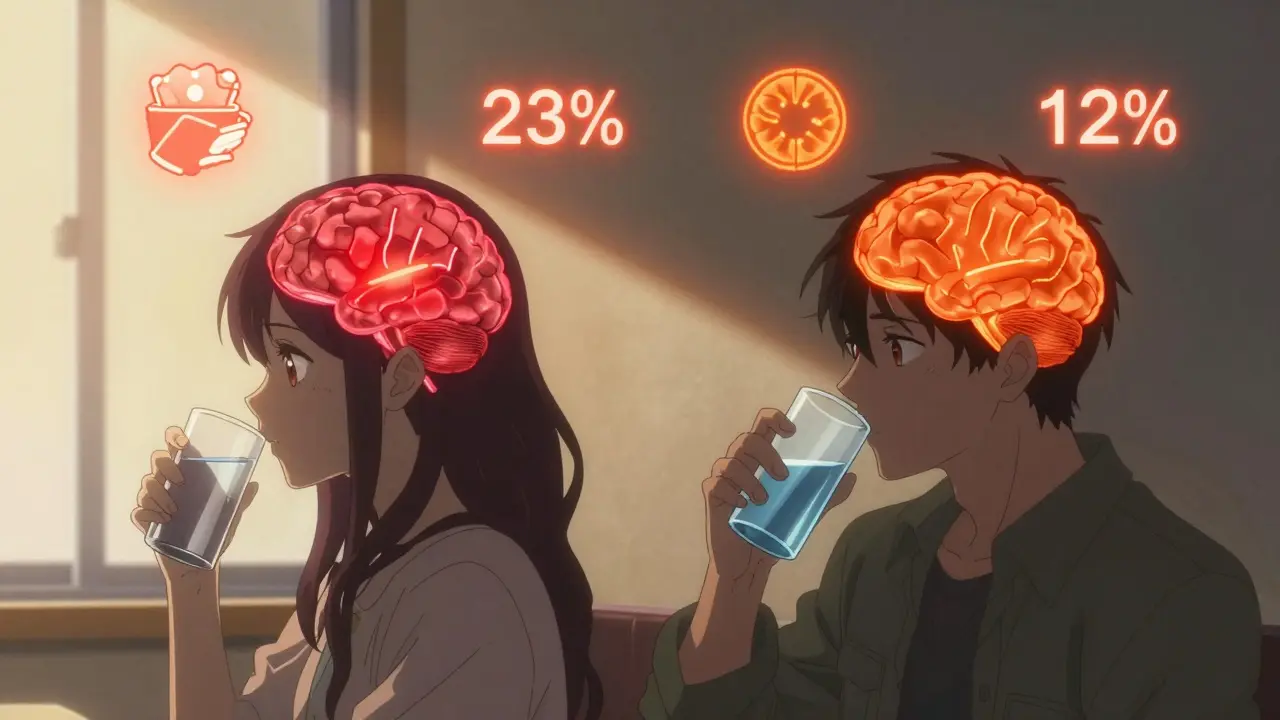
Not all sweeteners are the same
Aspartame, sucralose, acesulfame potassium, stevia, monk fruit-they’re not interchangeable. Aspartame (found in Diet Coke and Equal) has been linked in some studies to increased appetite in men. Sucralose (Splenda) messes with hunger hormones. Acesulfame potassium (often paired with sucralose) may trigger insulin responses even without sugar. Meanwhile, stevia and monk fruit-natural alternatives-show fewer appetite disruptions in user reports. Amazon reviews show Truvia (stevia-based) gets 4.2 stars with only 15% of negative reviews mentioning cravings. Splenda? 3.8 stars, with 28% of complaints about increased hunger.What the science says about weight loss
The data is messy. Some studies say artificial sweeteners help. Others say they hurt. A 2021 meta-analysis of 15 trials found people consumed 112 fewer calories per day when swapping sugar for artificial sweeteners. That’s about 800 calories a week. Over a year? That’s a 10-pound difference. But here’s the catch: those benefits mostly show up in short-term studies (under 4 weeks). Long-term? A 2024 study from the German Diabetes Center found sucralose increased activity in hunger centers of the brain by 34% after three months. So yes, you might lose weight at first. But over time, your body might fight back.Real people, real results
On Reddit’s r/loseit, 68% of 1,247 users said artificial sweeteners helped reduce cravings. But 32% said they made things worse-especially after months of daily diet soda use. A 2023 American Diabetes Association survey of 4,500 people with type 2 diabetes found 74% had better blood sugar control with sweeteners, but 41% felt hungrier. The same pattern shows up in dietitian clinics: people switch to diet products, feel better for a few weeks, then start snacking more. It’s not laziness. It’s physiology.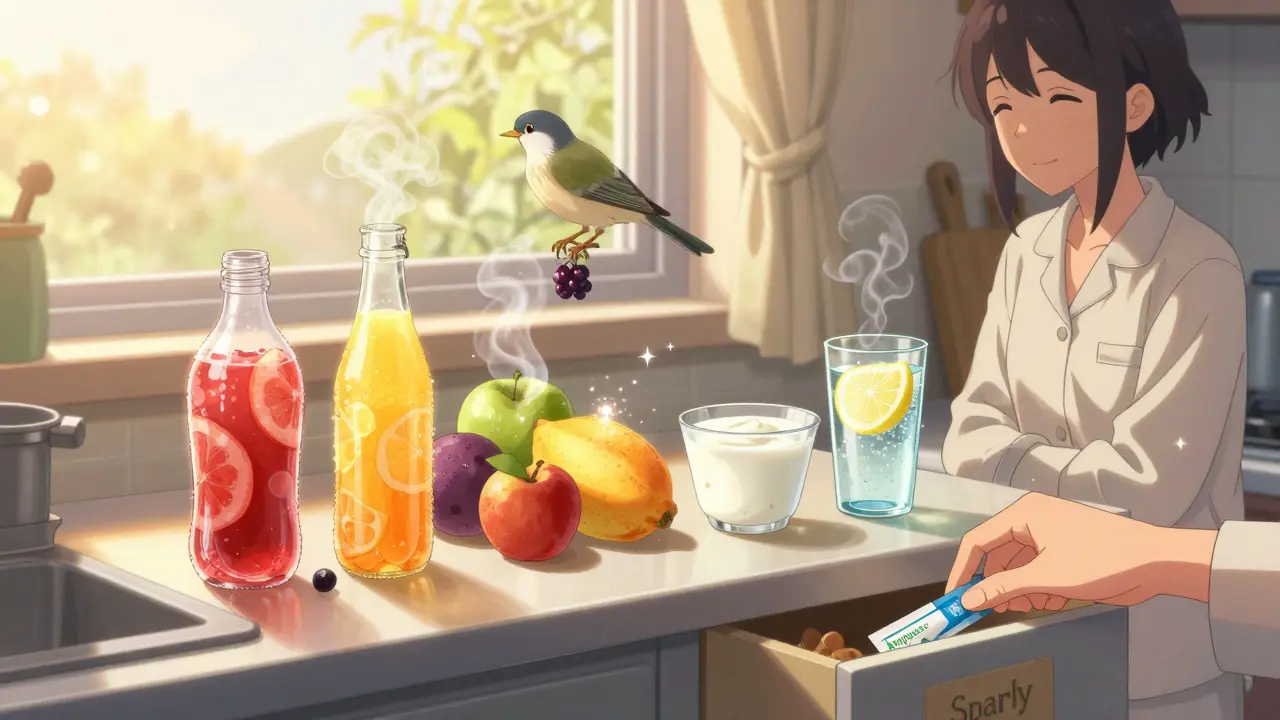
How to use sweeteners without triggering cravings
If you’re going to use them, use them wisely. Start with lower-intensity sweeteners like monk fruit or stevia instead of sucralose or aspartame. Avoid diet sodas with multiple sweeteners-blends like sucralose + acesulfame K are more likely to confuse your brain. Pair sweeteners with protein or fiber. A 2021 study showed adding sweetener to Greek yogurt reduced hunger by 22% compared to sweetener alone. And give yourself time. Most people need 2-3 weeks to adjust. Cravings may spike at first, then settle. But if you’ve been using them daily for six months and feel hungrier? That’s a red flag.The reset plan
If you suspect artificial sweeteners are making you crave more sugar, try a 4-6 week break. Cut out diet sodas, sugar-free gum, flavored yogurts, and low-calorie snacks with artificial sweeteners. Replace them with water, herbal tea, or sparkling water with lemon. You’ll likely feel more hungry at first. That’s normal. Your brain is recalibrating. After a few weeks, your taste buds reset. You’ll start enjoying the natural sweetness in fruit again. And you’ll stop chasing that artificial high.Bottom line: It’s not one-size-fits-all
There’s no universal answer. Some people lose weight with diet soda. Others gain weight. Some feel fine. Others feel out of control. Your body’s response depends on your sex, weight, metabolic health, and how long you’ve been using sweeteners. If you’re using them to manage diabetes, they can be a useful tool-just monitor your hunger. If you’re using them to lose weight and you’re hungrier than before? It might be time to try something else.The goal isn’t to eliminate sweetness. It’s to stop letting your brain be tricked. Real food-fruit, yogurt, dark chocolate-can satisfy cravings without the backlash. And if you need a little sweetness? Use it sparingly. Not every day. Not every meal. Just enough to enjoy, not to chase.
Releted Post

Caspian Fothergill
Hello, my name is Caspian Fothergill. I am a pharmaceutical expert with years of experience in the industry. My passion for understanding the intricacies of medication and their effects on various diseases has led me to write extensively on the subject. I strive to help people better understand their medications and how they work to improve overall health. Sharing my knowledge and expertise through writing allows me to make a positive impact on the lives of others.
Interesting breakdown. I’ve been swapping sugar for stevia in my coffee for months and honestly, my afternoon crashes stopped. Didn’t notice cravings until I started drinking diet soda daily. Now I stick to sparkling water with lemon. No magic fix, but it helped.
Also, the part about women’s brain response made me nod hard. Been there.
LMAO they’re all just scared of Big Sweetener. You think this is science? Nah. It’s the FDA and soda companies running a psyop so you keep buying their overpriced junk. Sucralose is just chlorinated sugar-think about that. They’re poisoning you slowly and calling it ‘diet.’ Wake up.
Also, the ‘women respond differently’ thing? That’s just them blaming hormones because they don’t want to admit their own weakness.
Let’s be perfectly clear: the entire premise of artificial sweeteners as a ‘health tool’ is a catastrophic failure of neuroendocrinology and public health policy. The brain’s reward system is not a suggestion box-it’s a hardwired evolutionary feedback loop that has been deliberately exploited by food manufacturers who understand dopamine better than most nutritionists. When you introduce a non-caloric sweetener, you are not ‘reducing sugar’-you are creating a persistent state of metabolic dissonance, wherein the body’s predictive coding mechanisms are constantly violated, leading to compensatory hyperphagia, particularly in individuals with preexisting insulin resistance. The 2024 German Diabetes Center study is not an outlier-it’s the logical endpoint of decades of nutritional misdirection. And yet, we still have people posting about ‘steaming lemon water’ as if it’s a cure, rather than a band-aid on a hemorrhaging artery.
Also, the fact that Amazon reviews are being cited as ‘evidence’ is frankly embarrassing. You wouldn’t cite Yelp reviews for neurosurgery. Why are you doing it for biochemistry?
Ugh. Another ‘science’ post trying to guilt-trip people into drinking water. Look, I don’t care if sucralose makes your brain think it’s starving. I’m not gonna give up my Diet Coke just because some lab rats in Germany got weird brain scans. This country runs on caffeine and sugar substitutes. If you can’t handle it, don’t drink it. Don’t make the rest of us feel bad for surviving on zero-calorie soda and protein bars.
Also, ‘natural’ sweeteners? Stevia tastes like grass. Monk fruit? Like chemical candy. Give me the real thing or give me nothing.
ok but why does diet coke make me want to eat a whole pizza at 2am?? 🤡 i thought i was being smart switching to it and now my cravings are outta control. also i swear my skin broke out after 3 weeks. is that a thing?? anyone else??
ps: stevia in my tea is fine but the diet soda? nope. nope. nope.
Thank you for writing this. 💛
I switched to diet soda to lose weight after my second kid. Thought I was being healthy. Turns out I was just training my brain to crave more sugar. After 6 weeks off everything artificial? I started liking the taste of actual fruit again. Like… actually enjoying it. No more ‘I need something sweet NOW’ panic.
Also, the part about pairing sweeteners with protein? Game changer. A spoon of peanut butter with my stevia coffee? Full for hours. 🙌
Okay but can we talk about how this is literally just a woman thing? I’ve been on diet soda since college and I’ve watched my mom, my sister, my bestie-ALL of them-go from ‘I’m fine’ to ‘I’m eating cookies at midnight like a vampire’ after 3 months. Meanwhile my boyfriend drinks 3 a day and says he feels ‘fine.’
And don’t even get me started on the ‘natural sweeteners’ hype. Stevia is NOT natural. It’s lab-processed. Monk fruit? It’s a miracle fruit that costs $12 a jar. Who’s even buying this? The rich? The gullible? The Instagram wellness cult?
Meanwhile, real sugar? Yeah, it’s bad. But at least you know what you’re getting. Artificial stuff? It’s like eating a ghost.
They lie. Sweeteners make you fat. End of story.