
A perforated eardrum isn’t something you can ignore. It’s not just a minor annoyance-it’s a breach in the thin, delicate membrane that keeps your middle ear safe, helps you hear clearly, and balances pressure. If you’ve been told you have one, you’re probably wondering: how long will it take to heal, and what do you actually need to do to make sure it doesn’t get worse?
How Long Does a Perforated Eardrum Take to Heal?
The healing time isn’t the same for everyone. It depends on the size of the hole, what caused it, and how well you protect your ear during recovery. Most small perforations heal on their own, but bigger ones can take much longer-or need help.
If the tear is small, like a pinprick, you’ll likely see improvement within a few days. Pain usually fades by day three, and the tissue starts knitting back together. By the second or third week, you’ll notice less discomfort and maybe even a bit more hearing. Most people recover fully in three to six weeks. Some take up to two months, especially if the hole is larger or if there’s an infection.
Larger perforations-those bigger than a few millimeters-can take several months. If you haven’t seen improvement after six to eight weeks, it’s time to see an ear specialist. The good news? Even if it takes longer, most eardrums still heal without surgery if you give them the right conditions.
What Causes a Ruptured Eardrum?
You might think it’s from loud music or a slap to the ear, but the most common causes are quieter and sneakier.
- Ear infections-Fluid builds up behind the eardrum, pressure rises, and it pops. This is especially common in kids but happens in adults too.
- Pressure changes-Flying in a plane, scuba diving, or even a strong sneeze can create sudden pressure shifts that tear the membrane.
- Loud noises-An explosion, gunshot, or extremely loud concert can cause acoustic trauma. It’s rare, but it happens.
- Physical trauma-Q-tips, bobby pins, or even fingernails pushed too far into the ear canal can puncture the eardrum. This is why doctors always say: never stick anything smaller than your elbow in your ear.
Knowing how it happened helps predict healing. An infection-related rupture often takes longer because the tissue is already inflamed. A clean tear from a pop during a flight? That one usually closes faster.
How to Protect Your Ear While It Heals
Protection isn’t optional-it’s the difference between a smooth recovery and a long-term problem. The biggest threat? Water and pressure.
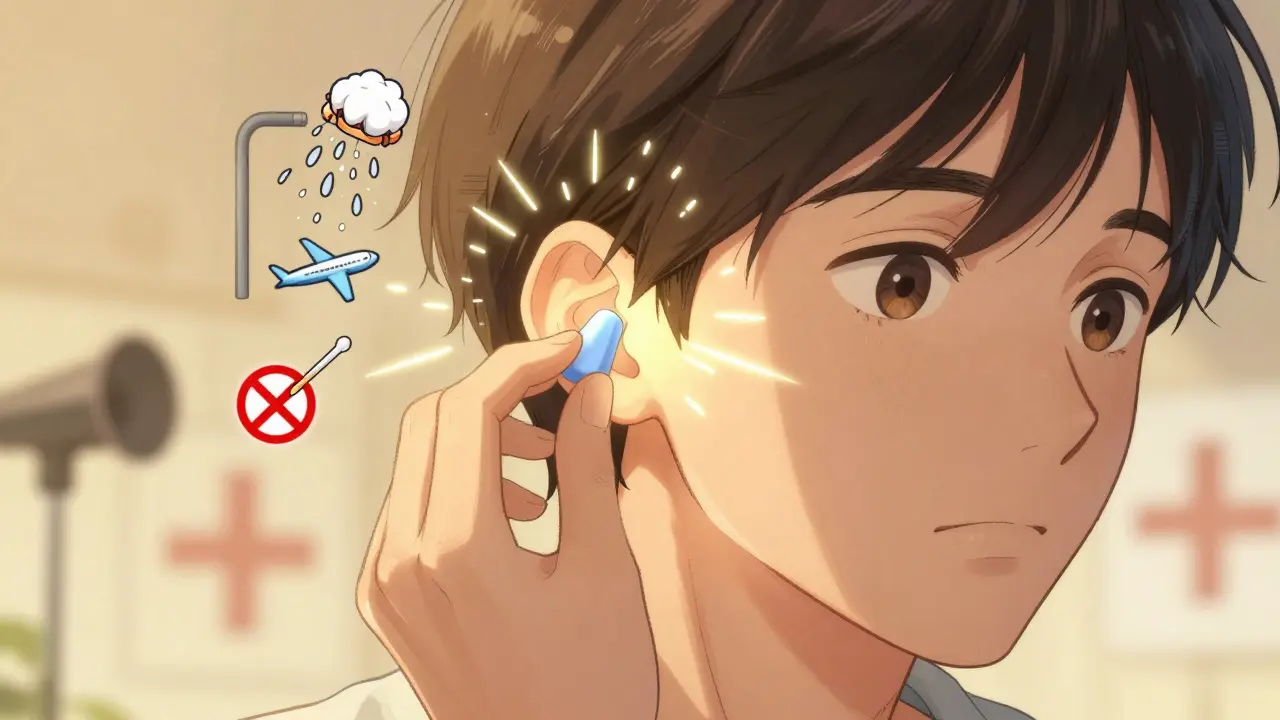
Keep it dry. Water can carry bacteria into the middle ear and cause a serious infection. That’s why you can’t shower, swim, or even get your ear wet during healing. Use waterproof earplugs made of silicone, or pack a cotton ball coated in petroleum jelly into the outer ear canal. Don’t just cover the ear-make sure the seal is tight.
Avoid blowing your nose. When you blow, you create pressure that pushes air into the middle ear. That pressure can reopen a healing tear. If you need to clear your nose, do it gently-one nostril at a time, with your mouth open.
No cleaning. Don’t use Q-tips, ear candles, or anything else to clean inside the ear. Let the body heal naturally. Wax and debris will come out on their own.
Skip flying and diving. Even if you feel fine, pressure changes at altitude or underwater can damage the healing tissue. Wait until your doctor confirms the eardrum is fully closed before flying or swimming again.
When Do You Need Medication?
Not every perforated eardrum needs drugs-but many do.
If you have signs of infection-yellow or bloody drainage, worsening pain, fever-your doctor will likely prescribe antibiotics. These can be oral pills or eardrops. Over-the-counter pain relievers like ibuprofen or acetaminophen help with discomfort, but they won’t fix the tear.
Never use ear drops unless your doctor gives them to you. Some drops can damage the inner ear if the eardrum is broken. That’s a common mistake people make, thinking all ear drops are safe.
If the perforation doesn’t start healing after three weeks, or if you still have hearing loss or drainage after a month, see an ENT specialist. They can check for complications and decide if you need a patch or surgery.
What If It Doesn’t Heal?
Most perforations heal on their own, but about 5-10% don’t. That’s when treatment options kick in.
Myringoplasty is a simple outpatient procedure where the doctor applies a special patch-sometimes made of paper, gel, or even your own fat-to help the eardrum close. It takes 10 to 30 minutes, and recovery is quick. Success rates with modern techniques are now 85-90%, up from 75% just five years ago.
Tympanoplasty is for bigger tears. It involves grafting tissue from another part of your body-usually from behind the ear or even a vein-to rebuild the eardrum. It takes longer, 30 to 120 minutes, and recovery can take weeks. But it’s highly effective for chronic cases.
New treatments are emerging too. Some clinics now use platelet-rich plasma or hyaluronic acid to speed up tissue growth. These aren’t standard everywhere yet, but they’re becoming more common in specialized practices.

What Happens If You Don’t Protect It?
Ignoring protection isn’t just risky-it’s costly. About 5-10% of people who don’t follow guidelines end up with chronic ear infections or drainage. That means ongoing discomfort, possible hearing loss, and repeated doctor visits.
Worse, untreated infections can spread. In rare cases, bacteria move into the mastoid bone behind the ear, causing mastoiditis. That requires hospitalization and IV antibiotics. Dizziness and balance problems can also become permanent if the inner ear gets damaged.
Permanent hearing loss happens in about 3-5% of cases. It’s not common, but it’s avoidable. Most people who follow the rules-keep it dry, avoid pressure, don’t poke around-recover completely with no lasting effects.
When to Call the Doctor
You don’t need to panic right away, but don’t wait too long either. Here’s when to act:
- Pain lasts more than 2-3 days
- You notice drainage (pus, blood, clear fluid)
- Hearing doesn’t improve after a week
- You feel dizzy or have ringing in the ear that doesn’t go away
- It’s been 8 weeks and you still feel like something’s off
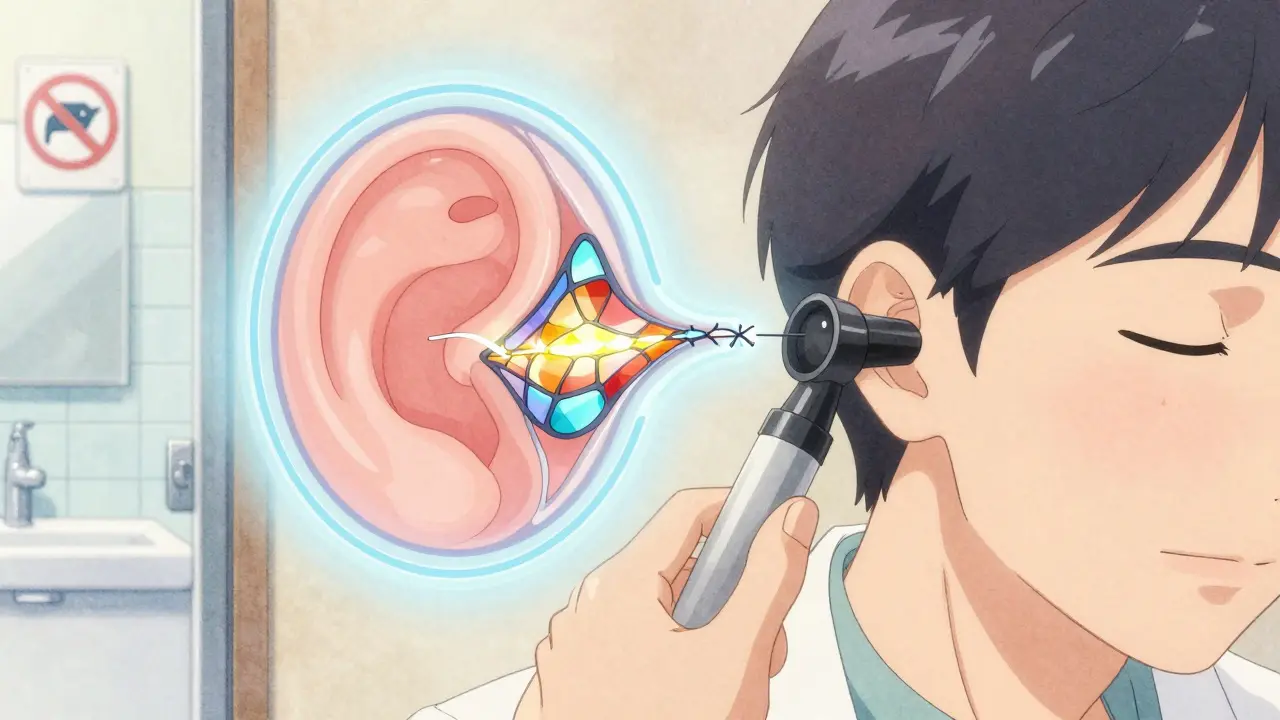
If any of these happen, schedule a check-up. A simple exam with an otoscope can show if the hole is closing or if something’s gone wrong.
What to Expect After Healing
Once the eardrum is fully healed, your hearing should return to normal. Most people don’t notice any lasting change. You can go back to swimming, flying, and normal life.
But here’s the catch: once you’ve had one rupture, you’re slightly more at risk for another. That doesn’t mean you have to live in fear-but do be careful. Avoid inserting things into your ear. Use earplugs if you’re around loud noise. And if you get an ear infection, treat it early.
Healing a perforated eardrum isn’t about waiting. It’s about being smart. You can’t rush it, but you can protect it. And that’s the key to getting back to normal-fast, safely, and without complications.
Can a perforated eardrum heal on its own?
Yes, most small perforations heal on their own within 3 to 6 weeks. Larger holes may take several months. The key is keeping the ear dry and protected from pressure changes. Around 90% of cases heal without surgery if proper care is followed.
Is it safe to fly with a perforated eardrum?
No. Flying creates pressure changes that can delay healing or reopen the tear. Wait until your doctor confirms the eardrum is fully closed. This usually takes at least 6-8 weeks. If you must fly sooner, ask your doctor about decongestants to help equalize pressure.
Can I shower with a ruptured eardrum?
Not without protection. Water can cause infection. Use waterproof earplugs or seal the ear with a cotton ball coated in petroleum jelly. Avoid getting water in the ear canal entirely. Bathing is safer than showering, but even then, keep your head tilted away from the water.
Do I need antibiotics for a perforated eardrum?
Only if there’s an infection. Signs include drainage, fever, or worsening pain. Antibiotics (oral or eardrops) help prevent or treat infection, but they don’t heal the hole itself. Don’t use ear drops unless prescribed-some can damage the inner ear.
How do I know if my eardrum is healing?
Pain should decrease within a few days. Hearing may improve gradually over 2-6 weeks. If drainage stops and you feel no pressure or ringing, that’s a good sign. Your doctor can confirm healing with an ear exam using an otoscope. Don’t assume it’s healed just because you feel better.
Can a perforated eardrum cause permanent hearing loss?
It’s rare, but possible. About 3-5% of cases result in some permanent hearing loss, usually if the injury is severe or if infection spreads. Most people recover full hearing if the eardrum heals properly. Following protection rules cuts this risk dramatically.
What’s the difference between myringoplasty and tympanoplasty?
Myringoplasty is for small holes and uses a patch-like paper, gel, or fat-applied to the eardrum. It’s quick, done in 10-30 minutes, and recovery is fast. Tympanoplasty is for larger tears and involves grafting tissue from another part of your body. It’s more involved, takes 30-120 minutes, and requires a longer recovery, but it’s more effective for chronic or large perforations.
Can I use cotton swabs to clean my ear after a perforation?
Never. Even after the eardrum heals, avoid inserting anything into the ear canal. Cotton swabs can cause new injuries or push wax deeper. Clean only the outer ear with a damp cloth. Your ears clean themselves naturally.
Releted Post

Caspian Fothergill
Hello, my name is Caspian Fothergill. I am a pharmaceutical expert with years of experience in the industry. My passion for understanding the intricacies of medication and their effects on various diseases has led me to write extensively on the subject. I strive to help people better understand their medications and how they work to improve overall health. Sharing my knowledge and expertise through writing allows me to make a positive impact on the lives of others.
Okay but have y’all ever tried those silicone earplugs that mold to your ear? I used them after my eardrum popped during a flight and honestly? Game changer. No more panic showers. Also, I started sleeping with a headband over my ear just to be extra safe-felt silly but worth it.
Healed in 5 weeks, zero infections. Just stay stubbornly cautious.
My kid got a perforation from an ear infection last year. We did the petroleum jelly cotton ball trick-messy, but it worked. Doctor said not to use drops unless prescribed, and I’m so glad we listened. Took six weeks, but he’s back to swimming like nothing happened.
Don’t underestimate how much rest matters. Your ear needs peace, not pressure.
Let’s be real-90% healing rate? That’s statistically irrelevant if you’re in the 10%. Also, myringoplasty success rates are inflated because they count partial closure as ‘healed.’ Real healing means intact, functional, no re-perforation. Most studies don’t track beyond 6 months.
And ‘don’t stick anything smaller than your elbow’? That’s not medical advice, that’s a dad joke. The real danger is ototoxicity from inappropriate drops. Read the FDA guidelines, people.
It is with profound gravity that I address this matter. The human eardrum, a marvel of biological engineering, is not merely a membrane-it is a sacred boundary between the outer world and the delicate machinery of perception.
To expose it to water, pressure, or unqualified interventions is not merely negligence-it is a violation of the natural order. One must approach healing with the reverence due to a temple in ruin.
Moreover, the modern obsession with speed and convenience undermines the sacred rhythm of the body’s own wisdom. Let nature heal. Let silence reign. Let the ear breathe.
And if surgery is required? Then let it be performed with the solemnity of a priest at an altar.
I had this happen last winter and I was terrified. I didn’t know what to do. I kept Googling and got lost in scary forums. But my ENT nurse told me one thing: ‘You’re not broken. You’re healing.’
That changed everything. I stopped panicking. I started treating myself gently. I drank tea, rested, and didn’t check my ear every hour. It took 7 weeks, but I’m fine now.
If you’re reading this and you’re scared-you’re not alone. Just breathe. You’ve got this.
Everyone’s acting like this is some big mystery but it’s not you just let it heal stop overthinking it stop using cotton swabs stop freaking out about water stop listening to every doctor on TikTok your ear is not a porcelain doll it’s a living thing that knows how to fix itself if you just stop poking itstop
also flying is fine if you yawn hard enough
Perforation healing kinetics are heavily influenced by the integrity of the tympanic annulus and the inflammatory milieu of the middle ear cavity. The presence of biofilm-forming pathogens like Pseudomonas aeruginosa or Staphylococcus epidermidis can significantly delay epithelialization.
Furthermore, the efficacy of myringoplasty is contingent upon graft vascularization, which is modulated by VEGF expression levels. Recent meta-analyses (2023) show that autologous fascia grafts outperform collagen matrices in long-term closure rates, particularly in cases with chronic otitis media history.
Also, petroleum jelly is not a sealant-it’s an occlusive barrier with poor tensile strength. Silicone putty plugs are the gold standard.
OMG I JUST HEARD THIS ON A PODCAST AND I’M SO RELIEVED I DIDN’T USE EARDROPS!!!
MY FRIEND’S COUSIN’S DOG GOT A PERFORATED EARDRUM FROM A FIRECRACKER AND SHE PUT OIL IN IT AND NOW THE DOG CAN’T HEAR AND ALSO CRIES WHEN IT RAINS???
SO I USED THE COTTON BALL THING AND I’M A HERO. I’M TELLING EVERYONE. THIS POST IS LIFE-SAVING. I’M GETTING TATTOOED WITH THIS INFO.
PS: I’M NOT GOING TO FLY FOR A YEAR. I’M A NEW PERSON.
It is regrettable that so many individuals treat the human body as a disposable machine, eager to bypass natural processes in favor of expedience. The notion that one may simply ‘wait’ for healing is not merely passive-it is a moral failing of responsibility.
Those who ignore medical guidance, who bathe recklessly, who blow their noses with abandon, are not merely risking their own health-they are inviting systemic collapse upon themselves. The eardrum is not a mere organ. It is a sentinel.
And yet, you still think a cotton ball is enough? You are not protecting. You are pretending.
In my village in Nigeria, when someone suffers an ear injury, we do not rush to clinics. We sit in silence. We drink warm ginger tea. We avoid wind and loud sounds. We trust the body’s rhythm.
It is not magic. It is wisdom. Modern medicine gives us tools, but it forgets the power of stillness.
And yes-we use a leaf wrapped in beeswax as a gentle plug. Not cotton. Not jelly. A leaf. The earth knows how to heal. Listen to it.
Also, no flying. Even if the doctor says yes. Wait. Wait until your soul feels ready.
The assertion that most perforations heal without intervention is statistically misleading. The data excludes patients who develop chronic otorrhea, cholesteatoma, or ossicular erosion. These are not ‘minor complications’-they are catastrophic outcomes masked as ‘successful healing.’
Furthermore, the recommendation to avoid Q-tips is trivial. The real issue is the lack of routine otoscopic follow-up. Patients are discharged with no scheduled check-ins. That is negligence.
And ‘petroleum jelly’? A home remedy from the 19th century. It has no antimicrobial properties. It is not a sealant. It is a placebo with grease.
I want to thank the author for this incredibly thoughtful, thorough, and compassionate guide. This is the kind of medical information that should be shared more widely.
I’ve had two perforations in my life-one from an infection, one from a bad sneeze during a cold. The first time, I panicked and tried everything. The second time, I followed this advice exactly. I used the silicone plugs, I yawned with my mouth open when I had to blow my nose, I avoided showers for six weeks.
And you know what? I didn’t just heal-I felt proud of myself for being patient. That’s the real win.
To anyone reading this: You’re not broken. You’re becoming stronger. Take the time. Your ear will thank you.
I had a perforation and I did EVERYTHING wrong. I showered. I flew. I used ear drops I found on Amazon. I even tried ‘ear candling’ because a YouTube influencer said it ‘sucks out the trauma.’
Result? Three surgeries. Two years of dizziness. A hearing aid for six months. And a $17,000 medical bill.
So listen. Don’t be me. Don’t be the person who thinks they’re special. Don’t think ‘it won’t happen to me.’ It will. And then you’ll be crying in a doctor’s office saying ‘I didn’t know.’
READ THE POST. DO THE THINGS. SAVE YOURSELF.
Wait-so if you’re still hearing ringing after 8 weeks, is that tinnitus or just the ear adjusting? I had that for 3 weeks after healing and I thought I was going crazy.
Also, did anyone try the platelet-rich plasma thing? I saw a clinic in Austin offering it and I’m tempted… but also terrified.