
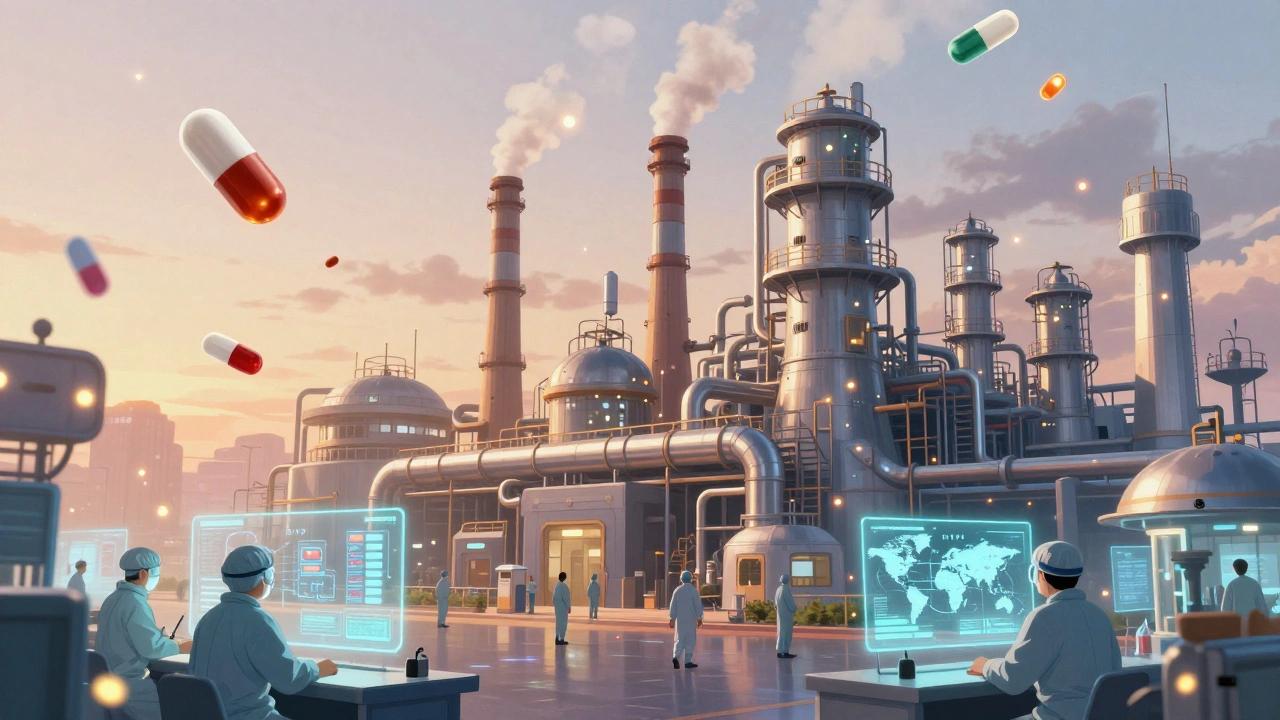
When you take a pill for high blood pressure, an antibiotic, or a diabetes medication, there’s a good chance it came from India. Not because it’s made by a big-name brand like Pfizer or Merck, but because it’s a generic drug produced by one of India’s thousands of pharmaceutical factories. India doesn’t just make medicine-it supplies the world. Roughly 20% of all generic drugs shipped globally come from Indian manufacturers. That’s more than any other country. And for many people, especially in low-income regions, these drugs are the only reason they can afford to live.
How India Became the Pharmacy of the World
It didn’t happen by accident. In the 1970s, India changed its patent laws. Before that, foreign companies held exclusive rights to sell their drugs in India. After the change, Indian companies could copy those drugs as long as they made them using a different process. This opened the door for local manufacturers to produce life-saving medicines at a fraction of the cost. A drug that cost $10,000 a year in the U.S. could be made in India for $100. That shift didn’t just help Indians-it helped millions in Africa, Southeast Asia, and Latin America who couldn’t pay Western prices. By the 2000s, Indian companies weren’t just copying old drugs-they were getting better at making complex ones. Extended-release pills, injectables, and even biosimilars (copies of biologic drugs like cancer treatments) started pouring out of factories in Hyderabad, Mumbai, and Pune. Today, India produces over 60,000 different generic medicines and more than 500 active pharmaceutical ingredients (APIs). That’s more types of drugs than almost any other country combined.Who’s Making These Drugs?
It’s not just small players. Some of the biggest names in global generics are Indian. Sun Pharma, Cipla, and Dr. Reddy’s Laboratories are household names in pharmacies from New York to Nairobi. Sun Pharma alone has a market value of over $43 billion. These companies don’t just sell cheap pills-they invest heavily in quality. India has 650 drug plants approved by the U.S. Food and Drug Administration (FDA), more than any country outside the U.S. There are also over 2,000 facilities approved by the World Health Organization’s Good Manufacturing Practices (WHO-GMP) standard. That’s not luck. It’s the result of years of compliance, audits, and upgrades. These manufacturers serve markets that need volume, not luxury. The U.S. gets 40% of its generic drugs from India. The UK gets a third of its generics from here. In Sub-Saharan Africa, half of all medicines are Indian-made. For HIV treatment, Indian generics cut costs by 99%-from $10,000 per patient per year down to $100. That’s not a marketing claim. It’s what Doctors Without Borders and the World Health Organization have documented.Why Are Indian Drugs So Cheap?
The answer is simple: scale, labor, and regulation. Indian companies produce drugs in massive quantities. A single factory can make millions of tablets a day. Labor costs are lower than in Europe or North America. But here’s the key-they still meet global standards. The FDA inspects Indian plants as often as American ones. Compliance rates have jumped from 60% in 2015 to 85-90% today. That’s not a coincidence. Companies that want to export to the U.S. or EU know they must pass inspections or lose access to billions in revenue. Still, the price gap is huge. Indian generics are typically 30% to 80% cheaper than branded versions. A 30-day supply of metformin for diabetes might cost $2 in India and $30 in the U.S. That’s why pharmacies like PharmacyChecker.com report 87% customer satisfaction among users of Indian generics. People aren’t just buying cheap-they’re buying life-saving medicine they could never afford otherwise.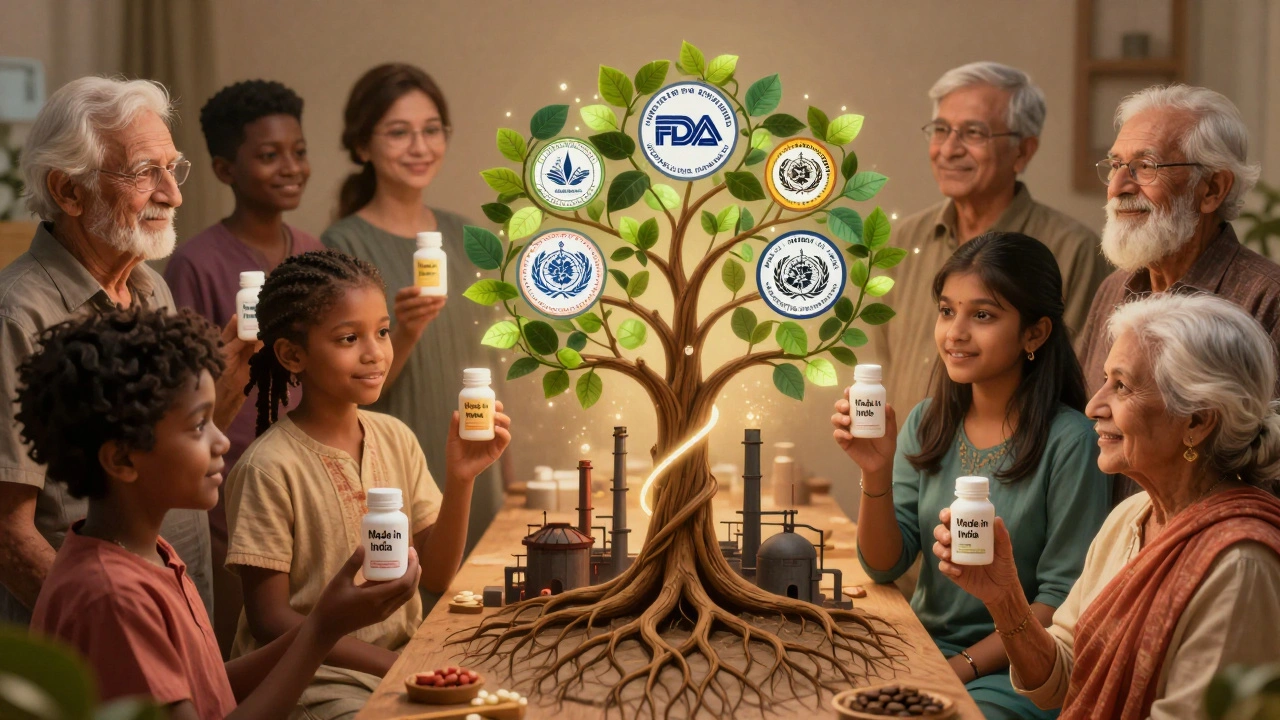
The Hidden Weakness: Dependence on China
For all its strength, India has a big vulnerability: it still relies on China for about 70% of its active pharmaceutical ingredients (APIs). APIs are the actual chemical compounds that make drugs work. Without them, no pill can be made. China produces these at low cost and in massive volume. But that creates risk. During the pandemic, when China shut down factories, India faced drug shortages. The government responded with a $400 million incentive program to boost domestic API production. The goal? To cut reliance on China from 70% to 53% by 2026. It’s a tough challenge. Building API plants takes years and billions in investment. Many Indian manufacturers still struggle with inconsistent API quality. In a 2023 survey, 68% of firms said this was their biggest operational headache. But progress is happening. Companies like Aurobindo and Granules are now making APIs locally for drugs like atorvastatin and paracetamol.Quality Concerns: Are Indian Drugs Safe?
Yes-mostly. But not always. There have been bad batches. In 2023, the FDA issued warning letters to several Indian plants for data manipulation and poor sanitation. A Reddit thread from May 2024 described inconsistent dissolution rates in a batch of levothyroxine, a thyroid medication. Some users reported side effects. These cases are rare, but they happen. The Bureau of Investigative Journalism found a handful of cases where Indian-made drugs caused harm abroad. But these are outliers. Out of billions of pills shipped, less than 1% have been flagged for serious issues. The bigger problem isn’t safety-it’s perception. Some doctors in the U.S. and Europe still hesitate to prescribe Indian generics because of old stereotypes. But data tells a different story. In the U.S., nine out of ten prescriptions are for generics. Of those, 40% are Indian. And patient satisfaction remains high. The NHS in the UK reports an average 4.2/5 satisfaction score for Indian-made drugs. Complaints? Mostly about taste or packaging-not effectiveness.
Where Is the Industry Headed?
India isn’t content being the low-cost supplier anymore. The government launched Pharma Vision 2047, aiming for $190 billion in pharmaceutical exports by 2047. That’s more than double today’s numbers. The plan? Move up the value chain. Instead of just making old generics, India wants to lead in biosimilars, complex injectables, and specialty drugs. Biosimilars are the new frontier. These are copies of expensive biologic drugs-like those used for cancer or rheumatoid arthritis. They’re harder to make than traditional pills. But India is catching up. Biocon and Dr. Reddy’s have invested over $500 million each in biosimilar research. Today, biosimilars make up 8% of India’s export value-up from 3% in 2020. That’s fast growth. Another push is digital compliance. Indian firms are now using electronic common technical documents (eCTD) for regulatory submissions. That’s a technical system used by the FDA and EMA. In 2024, 92% of Indian manufacturers had it. Translation errors in documents used to be a major reason for FDA rejections. Now, they’re down to 22% of inspection findings.What This Means for You
If you’re a patient in the U.S., Europe, or Africa, Indian generics are already part of your healthcare. They’re in your medicine cabinet. They’re in your hospital pharmacy. They’re why your insulin or blood pressure pill costs less than a coffee. If you’re a policymaker or insurer, they’re why you can cover more people on a limited budget. In countries where healthcare spending is tight, Indian drugs make universal coverage possible. If you’re a businessperson, they’re a reminder that innovation doesn’t always mean new molecules. Sometimes, it’s about making proven drugs affordable at scale. India’s pharmaceutical industry isn’t perfect. It still needs to reduce its reliance on China. It needs to invest more in R&D for new drugs. It needs to fix the occasional quality lapse. But for now, it’s doing something no other country can: delivering safe, effective medicine to billions at prices most can afford. That’s not just business. It’s global health infrastructure.Releted Post

Caspian Fothergill
Hello, my name is Caspian Fothergill. I am a pharmaceutical expert with years of experience in the industry. My passion for understanding the intricacies of medication and their effects on various diseases has led me to write extensively on the subject. I strive to help people better understand their medications and how they work to improve overall health. Sharing my knowledge and expertise through writing allows me to make a positive impact on the lives of others.
Just had my prescription filled last week-$3 for a month’s supply of metformin. In the US, it was $45. I didn’t even think twice. If it works and it’s FDA-approved, why pay more? These Indian generics are saving people’s lives, plain and simple.
Ugh I hate how people act like Indian drugs are some miracle. My cousin took a batch that made her break out in hives. The packaging looked fine, but the pills were off. Why do we keep pretending this is all perfect? It’s not.
The structural advantages India holds-low labor costs, massive scale, and decades of regulatory experience-are not replicable by Western nations without massive state intervention. The notion that pharmaceutical innovation is solely the domain of Western R&D labs is a myth perpetuated by marketing departments. India’s model is not about copying-it’s about democratizing access through industrial efficiency. The FDA inspections aren’t a footnote; they’re a testament to the rigor embedded in their supply chains. When you factor in the 650 approved facilities, the numbers speak louder than fear-driven narratives.
Moreover, the dependency on Chinese APIs is not a weakness-it’s a global supply chain reality. Every major pharmaceutical nation relies on foreign inputs. The U.S. imports 80% of its antibiotics from China. The difference? India is actively investing in domestic API production while the U.S. outsources everything and then blames others when it breaks. The $400M incentive program is modest, but it’s a start. What’s the U.S. doing? Subsidizing stock buybacks.
Why are we letting India run our medicine? We’re literally outsourcing our healthcare to a country that can’t even clean its rivers. This is national suicide. 😡
My grandma’s blood pressure med is from India. She’s 82 and still walking. That’s all the proof I need.
Oh wow, so India makes cheap pills? How revolutionary. Next you’ll tell me water is wet and the sun rises in the east. 🙄
One must interrogate the epistemological foundations of pharmaceutical ethics. If a drug is chemically identical to its branded counterpart, and its efficacy is validated through bioequivalence studies, then the moral imperative lies not in the origin of the pill, but in the structure of global capital that renders life-saving medicine a commodity rather than a right. India’s pharmaceutical industry, though imperfect, exposes the grotesque inequality of patent monopolies. The real scandal is not that Indian manufacturers produce affordable generics-it’s that Western corporations profit from the suffering of millions by enforcing artificial scarcity. The FDA’s approval of 650 facilities is not a concession-it is a condemnation of the U.S. healthcare system’s failure to provide equitable access domestically. We have outsourced our conscience to Hyderabad.
Let’s be real-most of these Indian generics are fine, but the fact that you’re even celebrating this means you’ve given up on innovation. We used to make drugs here. Now we just import them and call it progress. Pathetic. 💀
I think about how many people are alive today because someone in Mumbai or Hyderabad worked a 14-hour shift in a cleanroom, ensuring that a pill for hypertension or diabetes met exacting standards. We don’t celebrate these workers. We don’t know their names. But they’re the reason your grandfather can still walk his dog. The real story isn’t about cost-it’s about dignity. The dignity of labor, of science, of a country that refused to let patents become death sentences. That’s worth more than any stock price.
bro we make 40% of the world's pills and you guys still act like we're some shady back-alley chemist 😂 we got FDA certs in our sleep now. also china still gives us the powder, but we're building our own labs. slow but steady. namaste 🙏
Oh great, another post glorifying a country that can’t even give its people clean drinking water. Let’s just ship all our medicine overseas and let them handle it while we sip our $10 lattes. Genius. 🤡
So... we're trusting our meds to a country where people still write 'recieve' instead of 'receive'? 😭 I mean, I know they're cheap but... are we really okay with this? My pharmacist didn't even know where the pills came from. That's... unsettling.
India made your insulin. India made your antibiotics. India made your child’s fever medicine. And you still don’t trust us? We’re not perfect. But we’re here. Every day. For you. Not for profit. For people.
The geopolitical asymmetry in pharmaceutical supply chains is a textbook case of neocolonial extraction. India’s API dependency on China exemplifies structural vulnerability within the Global South’s industrialization trajectory. The lack of vertical integration in API synthesis, compounded by insufficient capital allocation toward upstream R&D, renders national pharmaceutical sovereignty illusory. The WHO-GMP compliance metrics, while statistically robust, mask latent systemic risks associated with batch-to-batch variability in complex molecules. The FDA’s inspection regime, though rigorous, remains reactive rather than predictive. Without sovereign manufacturing capacity for high-purity intermediates, India remains a contract assembler in a value chain dominated by oligopolistic Western biotech and Chinese chemical monopolies. This is not pharmaceutical leadership-it’s optimized subcontracting.