
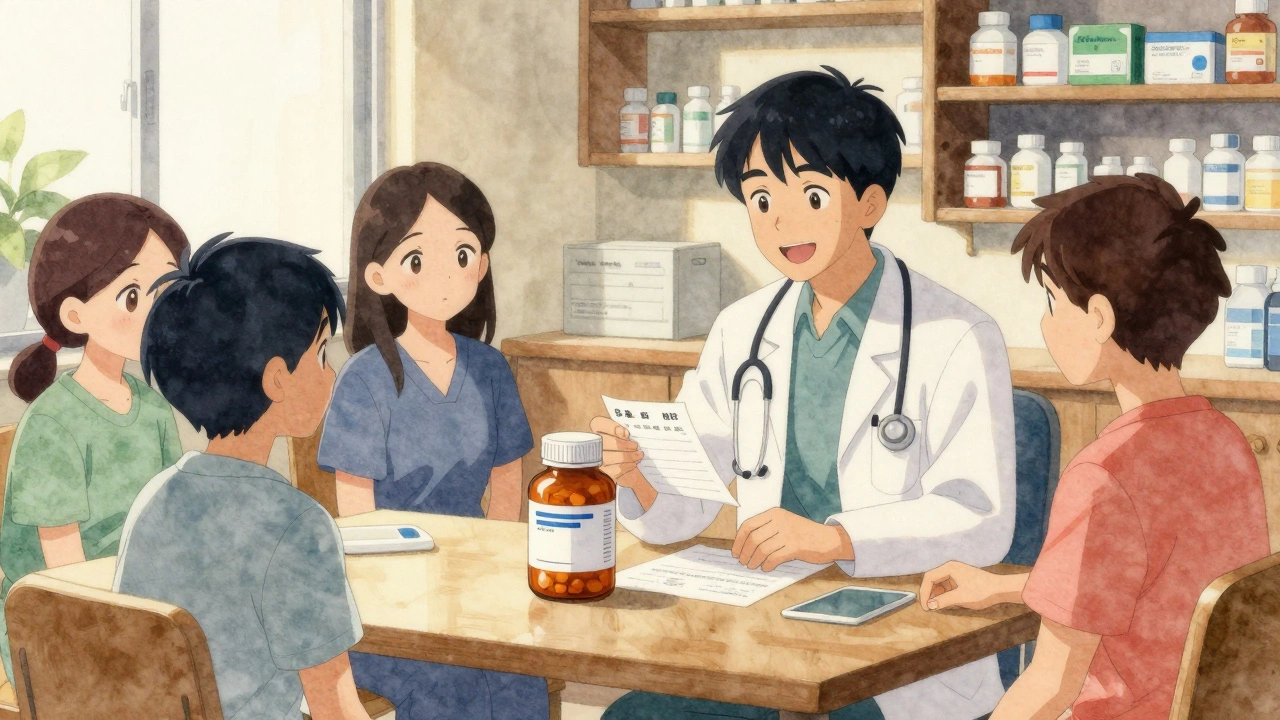
Switching to a generic drug can save you hundreds-or even thousands-of dollars a year. Yet, many people never ask their doctor about it. They assume the brand-name drug is better, or they don’t know how to bring it up without sounding like they’re cutting corners on their health. The truth? Generics are just as safe and effective for nearly every medication. The FDA requires them to have the same active ingredients, strength, dosage form, and performance as the brand-name version. In fact, 90 percent of all prescriptions filled in the U.S. are for generic drugs. The real question isn’t whether generics work-it’s why you haven’t asked your doctor yet.
What Exactly Is a Generic Drug?
A generic drug is a copy of a brand-name medication that becomes available after the original patent expires. It’s not a cheaper version. It’s the same medicine, made to meet the same strict standards. The FDA makes sure generics deliver the same clinical benefit as the brand-name drug. That means the active ingredient, how it’s absorbed, and how it works in your body are identical.
What’s different? The color, shape, flavor, or inactive ingredients (like fillers or dyes). These don’t affect how the drug works. A generic lisinopril for high blood pressure might look different from the brand-name Zestril, but it lowers your blood pressure the same way. And it costs a fraction of the price.
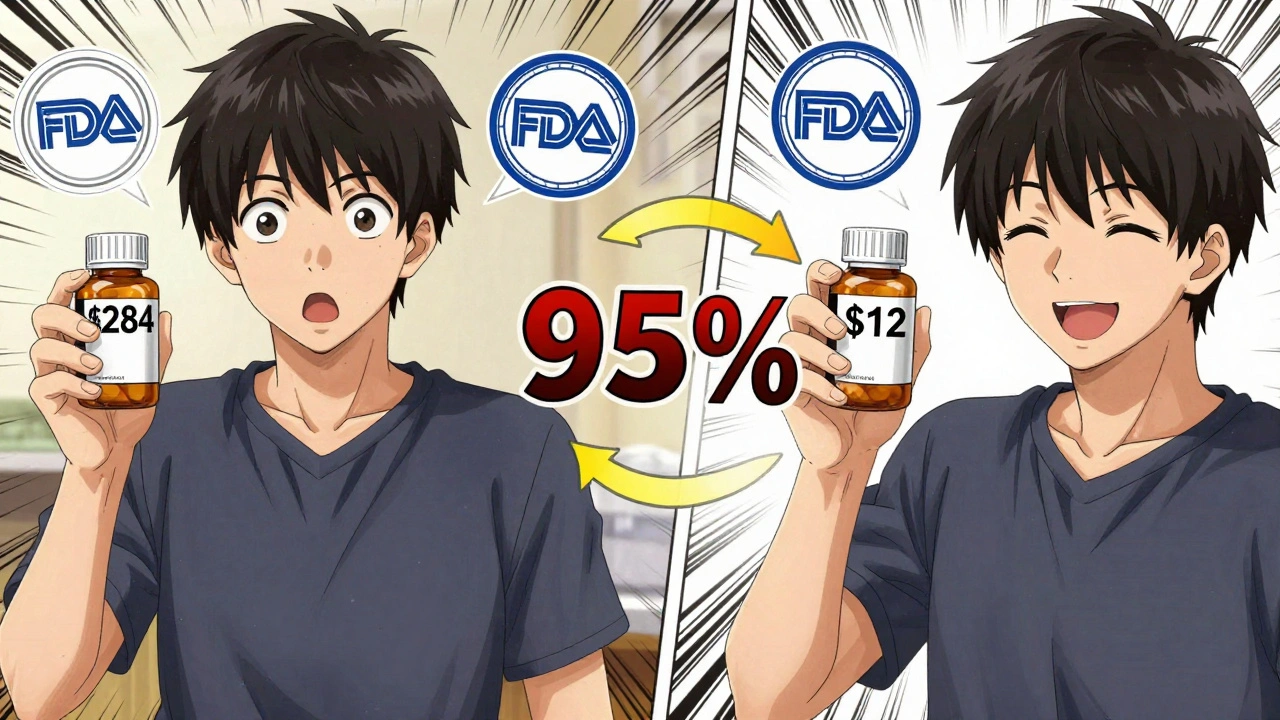
When multiple companies make the same generic, prices drop even more. After the first generic enters the market, prices often fall by 50 to 95 percent. For example, the brand-name drug Nexium costs around $284 for a 30-day supply. The generic omeprazole? About $4. That’s not a typo. That’s how much you can save.
When Generics Aren’t the Best Choice
There are exceptions. About 5 percent of medications have what’s called a narrow therapeutic index. That means even tiny differences in how the drug is absorbed can lead to big changes in how your body responds. These include:
- Warfarin (a blood thinner)
- Levothyroxine (for thyroid conditions)
- Some anti-seizure medications like phenytoin
- Certain immunosuppressants
For these drugs, staying on the same brand or even the same generic manufacturer can matter. A change in formulation-even if it’s still FDA-approved-might cause your blood levels to shift. That’s why your doctor might recommend sticking with one version. But even here, it’s not about brand vs. generic. It’s about consistency. If you’ve been stable on a generic for months, switching to another generic isn’t automatically risky. Talk to your doctor before making any changes.
Why Doctors Don’t Always Mention Generics
You might expect your doctor to automatically suggest a cheaper option. But most don’t. Why? Because they’re busy. They’re not tracking which generics just hit the market or which ones your insurance covers right now. A study from Cedars-Sinai found that most physicians can’t reliably recall which generics are available for every drug they prescribe.
Also, some doctors assume patients want the brand-name version because it’s what they’ve seen advertised. Others worry patients will think they’re being cheap. But the American Medical Association updated its policy in 2022 to encourage doctors to routinely discuss generics. They say the evidence is clear: for most drugs, generics are just as good.
How to Bring It Up Without Sounding Like You’re Trying to Save Money
You don’t need to say, “Can I get the cheap one?” That puts your doctor on the defensive. Instead, frame it as a shared goal: getting the best care at a price you can afford.
Here are real phrases that work:
- “Is there a generic version of this medication?”
- “Would it be safe and effective for me to use the generic?”
- “I’d like to explore options that work just as well but cost less.”
- “I want the most effective drug at the best price. Are generics appropriate here?”
These phrases shift the conversation from cost to safety and effectiveness. That’s what your doctor cares about.
Bring a list of your current prescriptions. If you know the brand name, write it down. Your doctor might not know the generic name offhand. You can also print a simple cost comparison. For example:
| Brand Name | Generic Equivalent | 30-Day Cash Price (Avg.) |
|---|---|---|
| Lipitor (atorvastatin) | Atorvastatin | $284 → $12 |
| Advair (fluticasone/salmeterol) | Fluticasone/salmeterol | $420 → $65 |
| Prozac (fluoxetine) | Fluoxetine | $200 → $10 |
| Humira (adalimumab) | Adalimumab | $6,300 → $4,480 |
Even with Humira, the generic still costs less-$1,820 per month less. That’s not just savings. That’s life-changing.
Timing Matters: Ask Before You Get the Prescription
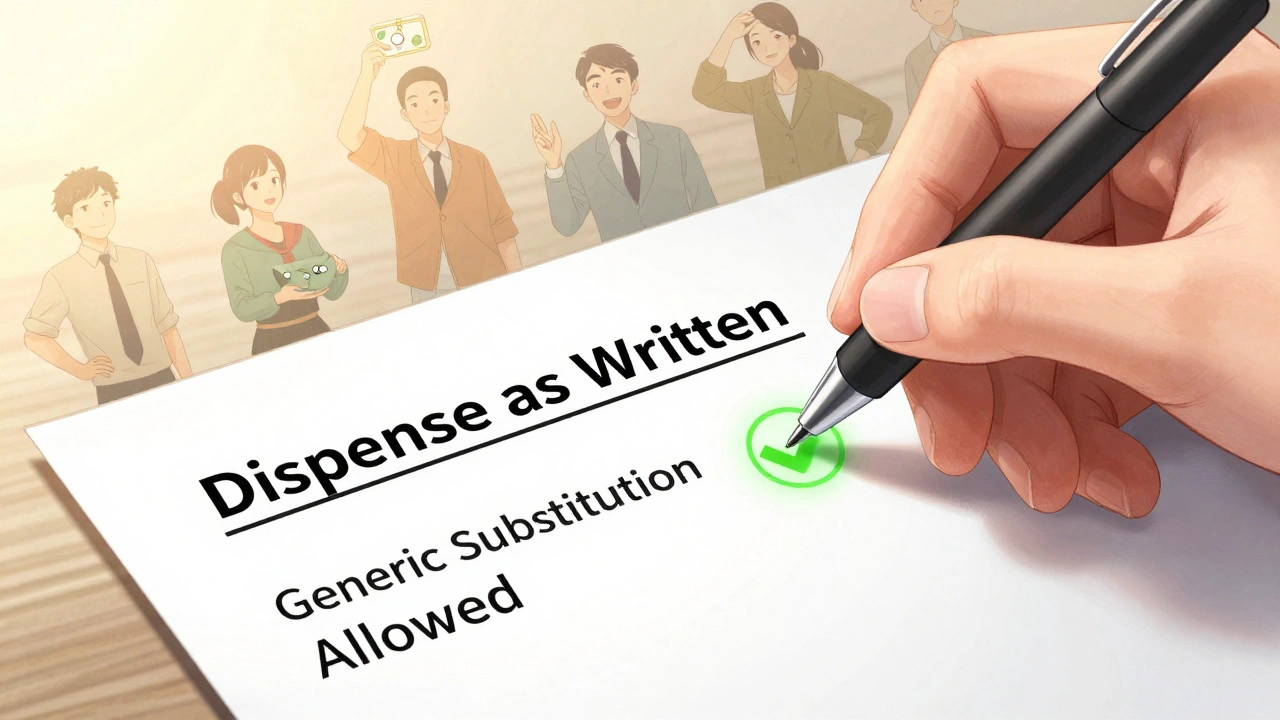
Don’t wait until you’re at the pharmacy and see the price. By then, you’ve already started the process. If your doctor writes a prescription that says “Dispense as Written” or “Do Not Substitute,” the pharmacist can’t switch it to a generic-even if one exists.
Instead, ask during the appointment. Say: “Can you write the prescription so that generic substitution is allowed?” That’s all it takes. Your doctor can easily change the note on the script. Pharmacists are trained to substitute generics unless told otherwise. In 48 states, they’re allowed to do it automatically.
What If Your Doctor Says No?
If your doctor says no, ask why. Not in a confrontational way. Just curious. Say: “I understand you’re recommending the brand-name version. Can you help me understand why?”
They might say:
- “This is a narrow therapeutic index drug.”
- “You’ve had side effects with other generics in the past.”
- “This specific brand has been shown to work better in your condition.”
If they say it’s because of the therapeutic index, ask which one. Then ask if switching to a different generic (not the brand) would be okay. Sometimes, the issue isn’t the generic-it’s switching between different generic manufacturers. If you’ve been stable on one generic, don’t switch unless your doctor says to.
If they say, “I’ve seen better results with the brand,” ask for evidence. Are they referring to a study? Or just personal experience? Most of the time, it’s the latter. The data shows generics work just as well for 95 percent of medications.
Insurance Plays a Big Role
Your insurance plan determines how much you pay out of pocket. Medicare Part D plans have the highest generic usage-89 percent of prescriptions filled are generic. Commercial insurance plans? About 72 percent.
Some plans require you to try the generic first before covering the brand. That’s called “step therapy.” Others have lower copays for generics. Check your plan’s formulary (the list of covered drugs). You can usually find it online or call customer service.
If your plan doesn’t cover the generic, ask your doctor if they can write a prior authorization. Sometimes, they can get the brand covered if there’s a medical reason. But if there’s no medical reason, the generic is almost always the better choice.
Real Stories: What Happens When People Switch
On Drugs.com, patients have reviewed over 450,000 medications. For common drugs like sertraline (Zoloft) and lisinopril (Zestril), 78 percent of people who switched to the generic reported no difference in effectiveness. Twelve percent noticed minor side effects-like a headache or upset stomach-but those usually went away after a few days. Those side effects were likely due to different inactive ingredients, not the active drug.
One patient with rheumatoid arthritis saved $1,820 a month by switching from Humira to its generic. Their disease stayed under control. Blood tests showed no change.
On the flip side, Johns Hopkins documented a case where a patient on levothyroxine had unstable thyroid levels after switching to a different generic. That’s why consistency matters for narrow therapeutic index drugs. But again-this wasn’t about generic vs. brand. It was about switching manufacturers.
What to Do Next
Start with your next prescription. Write down the names of your current medications. Look up their generic equivalents. Check the price difference. Then, next time you see your doctor, say:
- “I’ve been thinking about lowering my medication costs. Are there generics available for any of these?”
- “Can we review which ones are safe to switch to?”
- “Can you write the prescription so the pharmacist can substitute if needed?”
Don’t wait for your next appointment. Call your doctor’s office. Send a message through their patient portal. Ask now. You could save hundreds-or thousands-without changing how you feel.
Generics aren’t second-rate. They’re the standard. And you deserve to pay what’s fair for medicine that works just as well.
Are generic drugs really as effective as brand-name drugs?
Yes, for the vast majority of medications. The FDA requires generics to have the same active ingredient, strength, dosage form, and bioequivalence as the brand-name drug. Studies show that 95 percent of generic drugs perform identically in real-world use. The only exceptions are drugs with a narrow therapeutic index, like warfarin or levothyroxine, where small changes in blood levels can matter.
Why do generics cost so much less?
Brand-name drug companies spend millions on research, marketing, and patent protection. Once the patent expires, other companies can make the same drug without those costs. They don’t need to repeat expensive clinical trials. The result? Lower prices. When multiple companies make the same generic, competition drives prices down even further-often by 80 to 95 percent.
Can I switch from a brand-name drug to a generic anytime?
For most drugs, yes. But don’t switch on your own. Talk to your doctor first. If your medication has a narrow therapeutic index, switching between different generic manufacturers could affect your blood levels. Your doctor can help you choose the right one and monitor your response.
What if my pharmacist gives me a different generic than I’m used to?
Pharmacists are allowed to substitute generics unless your doctor says “Do Not Substitute.” If you notice a change in how you feel after switching generics, contact your doctor. For most people, it won’t matter. But for drugs like thyroid medication or seizure drugs, consistency matters. Ask your pharmacist to stick with the same manufacturer if you’ve been stable on one.
Will my insurance cover the generic?
Almost always. Most insurance plans have lower copays for generics. Some require you to try the generic first before covering the brand. Check your plan’s formulary or call your insurer. If your plan doesn’t cover a generic, ask your doctor if they can write a prior authorization or if there’s another generic option.
Releted Post


Caspian Fothergill
Hello, my name is Caspian Fothergill. I am a pharmaceutical expert with years of experience in the industry. My passion for understanding the intricacies of medication and their effects on various diseases has led me to write extensively on the subject. I strive to help people better understand their medications and how they work to improve overall health. Sharing my knowledge and expertise through writing allows me to make a positive impact on the lives of others.
Generics saved me $1,200 last year on my blood pressure med. I didn’t even notice a difference. My doctor was surprised I even asked.
The FDA doesn't regulate generics with the same rigor as brand name drugs and anyone who tells you otherwise is either misinformed or paid by Big Pharma
I've seen patients on generics crash into hospital beds because their labs were off by 30 percent and no one noticed until it was too late
They say 90 percent of prescriptions are generic but they don't tell you that 70 percent of those are filled by just three manufacturers who cut corners on fillers and coatings
And don't get me started on how pharmacists substitute without telling you
My grandfather died because they switched his levothyroxine to a cheaper version and no one checked his TSH for six months
Don't be fooled by the numbers
This is corporate greed disguised as cost saving
The real problem isn't the generic
It's that doctors are too busy to monitor
And patients are too scared to ask
And insurance companies are too greedy to care
So we all just suffer quietly
And call it progress
As someone from India where generics are the backbone of healthcare access, I can attest that these medications are not merely affordable but often life-sustaining
The regulatory frameworks in the United States are far more stringent than in many developing nations
Yet the skepticism persists despite overwhelming clinical evidence
It is not the medication that is inferior
It is the narrative that has been cultivated
Pharmaceutical marketing has conditioned patients to equate price with potency
This is a cultural and psychological barrier more than a medical one
When I first moved to the U.S.
I was shocked to learn that a medication I had taken for years at a fraction of the cost here was branded as a luxury
Generics are not a compromise
They are the standard
And the refusal to acknowledge this reflects a deeper inequity in how healthcare is valued
Oh great another article telling me I'm dumb for not asking for the cheap stuff
Let me guess you also think vaccines are a government plot and organic kale cures cancer
My grandpa took brand name Lipitor for 15 years and never had a heart attack
Now he's on generic and his cholesterol is up
And you want me to believe that's coincidence
Wake up America
They're trying to turn our healthcare system into a Walmart pharmacy
And you're the one handing them the shopping cart
Don't be a sheep
Ask for the real medicine
Not the knockoff
Thank you for writing this with such clarity
I've been advocating for generics with my elderly patients for years
One woman cried when she realized she could afford her diabetes meds again
It wasn't about the money
It was about dignity
Healthcare shouldn't be a luxury
And asking for a generic isn't being cheap
It's being smart
And brave
Because it means challenging the system
And your own assumptions
You're not just saving money
You're reclaiming agency
Let us consider the epistemological implications of pharmaceutical substitution in the context of late-stage capitalist healthcare commodification
Is the generic drug, then, merely a simulacrum of the original
Or does it represent a democratization of therapeutic access
And if we accept the FDA's equivalence claims
Are we not, in effect, endorsing a reductionist model of human physiology
Where biological individuality is subsumed under statistical norms
Moreover
Consider the psychological phenomenology of the patient who receives a pill that looks different
Does the color change not induce a nocebo effect
Is the shape not a symbolic erasure of identity
And when the pharmacist substitutes without consent
Is this not a violation of bodily autonomy
Yet
On the other hand
What moral imperative compels us to pay $300 for a molecule that costs $2 to synthesize
Is not the current system itself the true ethical failure
And so we are caught
In a paradox
Between justice and fear
Between economy and identity
Between trust and trauma
I used to think generics were risky until I switched my antidepressant
It took me three months to notice I hadn't had a panic attack in a row
Turns out
My body didn't care what the pill looked like
It just cared that the active ingredient was there
And now I can afford therapy too
That's the real win
Not just saving money
But being able to live
Without choosing between meds and rent
The bioequivalence thresholds established by the FDA for generics are intentionally narrow
Within the 80–125% confidence interval
There is still room for pharmacokinetic variance
Which may manifest as suboptimal therapeutic response in patients with polypharmacy
Especially those with hepatic enzyme polymorphisms
Or renal impairment
While population-level data supports equivalence
Individualized clinical outcomes remain heterogeneous
Thus
Standardized substitution protocols
May inadvertently compromise precision medicine
And this is not a critique of generics per se
But of the systemic decontextualization of pharmacotherapy
Where cost-efficiency eclipses individualized therapeutic monitoring
You people are so naive
Generics are not safe
They're made in factories where rats run free and the workers don't speak English
My cousin's friend's neighbor took a generic and his liver exploded
And you think that's okay because the FDA says so
The FDA is corrupt
They take money from Big Pharma
And they don't test the real stuff
They test the samples they're given
And those samples are clean
But the batch you get? Who knows
Stop being brainwashed
Stick with the brand
Even if it costs your mortgage
Just switched my dad to generic lisinopril last month
He was skeptical
Now he says he feels better than ever
And saved $180/month
He's been telling everyone at the senior center
You're not just saving money
You're giving yourself peace of mind
And that's priceless 💪
Why are you all so desperate to save money
Do you think your life is worth less than a $200 copay
My brother died because he switched to a generic
And the doctors didn't check his levels
And now you want me to believe this is normal
You're not being smart
You're being reckless
And you're making other people feel guilty for wanting the best
That's not progress
That's exploitation
The FDA's bioequivalence requirements for generics are based on average plasma concentrations
They do not account for inter-individual variability in absorption kinetics
Especially in geriatric populations with altered gastric motility
Or patients on multiple CYP450-metabolized agents
Therefore
Standard substitution
Is not a neutral act
It is a clinical intervention
That requires informed consent
And ongoing therapeutic monitoring
Yet neither is routinely practiced
Thus
While the theoretical equivalence holds
The practical implementation remains ethically fraught
They told me the same thing about the flu shot
And now look at the hospitals
They told me the same thing about vaccines
And now look at the deaths
They told me the same thing about generic insulin
And now look at the amputations
Don't be fooled
This isn't about cost
This is about control
They want you dependent
On their version
Of your health