
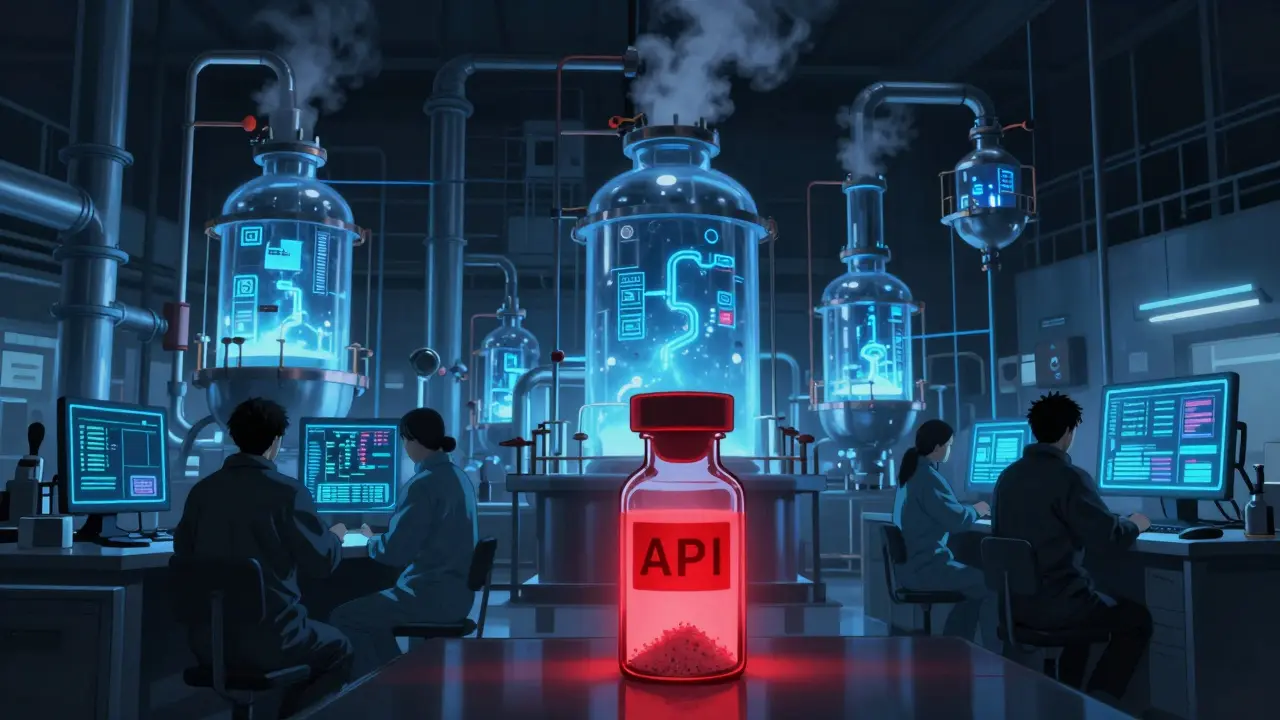
When you take a generic pill for high blood pressure, diabetes, or antibiotics, there’s a better than 70% chance that the active ingredient inside came from a factory in China. That’s not speculation-it’s fact. As of 2023, Chinese manufacturers supplied 80% of the world’s active pharmaceutical ingredients (APIs), the raw chemical building blocks that make generic drugs work. But behind that staggering scale lies a deepening crisis: quality control that often falls short of global standards, supply chains that are dangerously concentrated, and regulatory gaps that put patients at risk.
How China Became the World’s API Powerhouse
China didn’t become the dominant force in generic drug manufacturing by accident. After joining the World Trade Organization in 2001, the government poured billions into building chemical plants, training engineers, and offering tax breaks to pharmaceutical firms. By 2015, China’s healthcare reforms made domestic drug production a national priority. The National Medical Products Administration (NMPA) launched the Generic Consistency Evaluation (GCE) program in 2016, demanding that generics match the performance of branded drugs. But while the program cleaned up some factories, it didn’t fix the system. Today, companies like Sinopharm and Shijiazhuang Pharma Group churn out 500 to 2,000 metric tons of APIs per year-far more than any Western plant. Their secret? Vertical integration. They control nearly 70% of the supply chain, from the raw chemicals to the final purified ingredient. This cuts costs by 30-40% compared to U.S. or European makers. A kilogram of metformin API from China might cost $60. The same from Germany? $220. For drug companies trying to keep prices low, the choice seems obvious.The Hidden Risks in the Production Process
But low cost doesn’t mean safe. Chinese API production relies heavily on outdated batch processing-65% of facilities still use methods that haven’t changed since the 1990s. Meanwhile, U.S. and European plants have shifted to continuous manufacturing, which is more precise, less prone to contamination, and easier to monitor in real time. The most dangerous steps in API synthesis-like fluorination or reactions involving cyanide or azide compounds-are often done in China because of laxer environmental rules and lower labor costs. These processes are hazardous. In 2022, the FDA found that 78% of inspections at Chinese API facilities uncovered inadequate laboratory controls. That means tests weren’t done properly, or worse, results were altered. Another 65% of facilities failed to properly validate their manufacturing processes. If you don’t know exactly how a drug is made, you can’t guarantee it’s safe. Data integrity issues were cited in over half of inspections. That’s not just sloppy record-keeping-it’s fraud. In 2023, Zydus Pharmaceuticals recalled 1.2 million bottles of blood pressure medication after discovering the API from China’s Huahai Pharmaceutical was under-potent. Patients weren’t getting enough of the drug. That’s not a minor error. It’s life-threatening.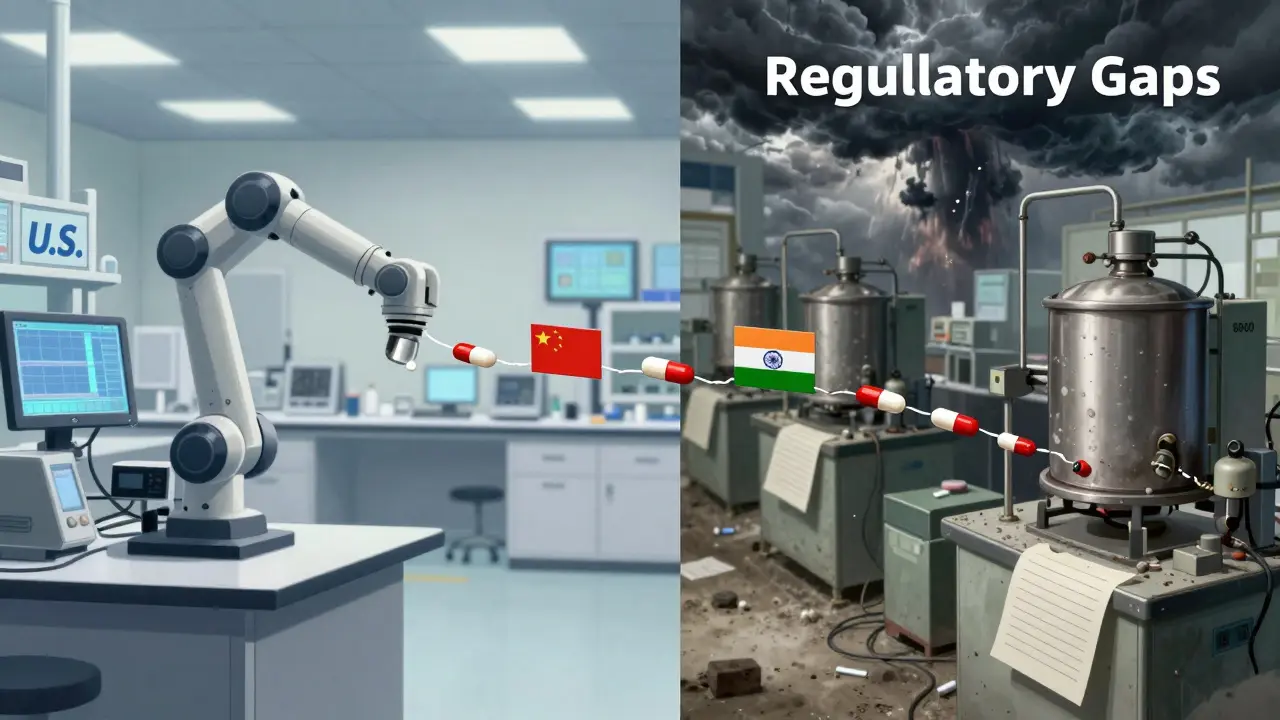
Quality Gaps That Can’t Be Ignored
The numbers don’t lie. A 2023 FDA study found that 12.7% of API samples from China failed purity tests. Compare that to 2.3% from Europe and 1.8% from the U.S. That’s a six-fold difference. And it’s not just about purity. Inconsistent dosing, impurities, and microbial contamination are recurring problems. A 2023 survey by PhRMA found that 68% of U.S. generic drug makers had experienced quality issues with Chinese-sourced APIs. Forty-two percent reported inconsistent purity levels. Thirty-seven percent said they’d seen falsified documentation. One quality assurance specialist on Reddit shared that Chinese-sourced metformin required 37% more retesting than Indian-sourced material. That’s not efficiency-it’s waste, risk, and delay. The problem isn’t just the factories. It’s the system. The NMPA inspects far fewer facilities than the FDA inspects in the U.S. Dr. Margaret Hamburg, former FDA commissioner, testified in 2024 that the FDA inspects Chinese plants at one-tenth the rate of domestic ones. Why? Access restrictions. China doesn’t always let inspectors in. Even when they do, the timeline is tight. A typical inspection lasts three days. In the U.S., it’s often two weeks.Why Finished Drugs Don’t Come From China
Here’s the twist: China makes 80% of the world’s APIs, but only 5-7% of finished generic pills. Why? Because the real value isn’t in the powder-it’s in the tablet. Formulating a drug, ensuring it dissolves properly, packaging it safely, and meeting shelf-life requirements takes expertise China hasn’t fully mastered. That’s where India comes in. India imports 65% of its APIs from China and turns them into pills that are sold globally. India’s strength isn’t in making the chemical-it’s in making the medicine work right in the body. China dominates the first half of the chain. India dominates the second. Together, they form a fragile link. The U.S. and Europe are now trying to break that link. The European Union’s 2024 Pharmaceutical Strategy aims to cut API dependence on China from 80% to 40% by 2030. The U.S. CHIPS and Science Act allocated $500 million to rebuild domestic API production. Vietnam and Mexico are also stepping up, offering lower costs than the U.S. with better oversight than China.
What’s Being Done-and What’s Not
China’s government claims progress. The NMPA says it has shut down 80% of non-compliant factories since 2015. It now requires ICH Q7 guidelines in 95% of GMP-certified plants. And in 2024, it launched “Pharma 2035,” a $22 billion plan to upgrade technology and increase FDA-inspected facilities from 187 to 500 by 2027. But here’s the catch: those upgrades are slow. Only 35% of Chinese generic drugs have completed the GCE program as of 2024. And even when they do, it doesn’t guarantee safety. The program checks bioequivalence-it doesn’t audit every batch. And while electronic submissions (eCTD) are now required, the real test is whether inspectors can find real problems, not just paperwork. Western companies that try to work with Chinese suppliers face a steep learning curve. Building an FDA-compliant API plant in China costs $85-120 million. Non-compliant? $50-75 million. Many choose the cheaper route. It takes 18-24 months to get compliance right. Pfizer’s joint venture with Huahai took three years and $22 million in upgrades before FDA approval.Who Pays the Price?
The cost savings are real. A company that switches from Indian to Chinese API for amoxicillin can save $4.2 million a year. But when a batch fails, the cost isn’t just financial. It’s patient trust. It’s delayed treatments. It’s recalls that make people question whether their medicine will work. Dr. Andrew von Eschenbach, former FDA commissioner, called China’s control over key starting materials a “national security vulnerability.” He’s right. Over 90% of essential medicines rely on chemicals that come from China. If trade is disrupted-by war, sanctions, or a pandemic-hospitals could run out of life-saving drugs overnight. China’s dominance isn’t going away anytime soon. But it’s becoming less reliable. As India, the U.S., and others build capacity, the global market will shift. McKinsey predicts China’s API market share will drop from 78% in 2023 to 65% by 2030. That’s still huge-but it’s a warning. The real question isn’t whether Chinese generics are cheap. It’s whether they’re safe enough. And for millions of people who depend on these drugs every day, the answer is still uncertain.Are Chinese generic drugs safe to take?
Many Chinese-made generic drugs are safe and effective, especially those that have passed FDA or EMA inspections. But not all do. Roughly 12.7% of API samples from China failed purity tests in a 2023 FDA study, compared to under 2% from the U.S. and Europe. If your drug comes from a manufacturer with a history of FDA warning letters, ask your pharmacist for the source. Look for brands that disclose their API origin.
Why are Chinese generic drugs so much cheaper?
China’s lower labor costs, government subsidies, relaxed environmental regulations, and vertical integration-controlling everything from raw chemicals to final API-cut production costs by 30-40%. They also use older, less expensive manufacturing methods. But lower cost doesn’t always mean lower risk. Cutting corners on quality control can lead to impurities, inconsistent dosing, or even contamination.
How can I tell if my medication uses Chinese-sourced ingredients?
Most generic drug labels don’t list the API source. But you can ask your pharmacist or contact the manufacturer directly. Some companies voluntarily disclose this on their websites. You can also check the FDA’s Drug Shortages database or the European Medicines Agency’s public reports for recalls tied to Chinese suppliers. If your drug was recalled for potency or purity issues, trace the source.
Is India a safer alternative to China for generic drugs?
India has a better track record for finished drug formulations and regulatory compliance. While India imports 65% of its APIs from China, its own manufacturing standards for pills are generally stronger. Indian companies have more experience with FDA inspections and export compliance. But if the API comes from China, the risk doesn’t disappear-it just moves one step up the chain.
What’s being done to fix quality issues in Chinese drug manufacturing?
China’s NMPA has shut down over 4,500 non-compliant factories since 2018 and launched the Generic Consistency Evaluation program. It’s also investing $22 billion through 2035 to modernize plants and increase FDA-inspected facilities. But progress is slow. Only 35% of generics have completed the evaluation, and FDA access remains limited. Real change will require transparency, not just policy announcements.
Should I avoid generic drugs made in China?
Not necessarily. Many life-saving generics-like metformin, lisinopril, and atorvastatin-are made in China and work perfectly. The key is knowing your supplier. If your pharmacy or insurer switches your drug to a new generic without warning, ask if the manufacturer has FDA approval and a clean inspection history. Don’t assume all generics are equal. Your health isn’t worth the gamble.
Releted Post

Caspian Fothergill
Hello, my name is Caspian Fothergill. I am a pharmaceutical expert with years of experience in the industry. My passion for understanding the intricacies of medication and their effects on various diseases has led me to write extensively on the subject. I strive to help people better understand their medications and how they work to improve overall health. Sharing my knowledge and expertise through writing allows me to make a positive impact on the lives of others.
Look, I get that China makes cheap stuff. But when your life depends on a pill, ‘cheap’ shouldn’t be the first word that comes to mind. I’ve been on lisinopril for eight years. My last batch? Felt like it was made out of crushed chalk and regret. My pharmacist didn’t even blink when I asked about the origin. That’s the problem-we’ve normalized this. We treat medicine like a commodity, not a lifeline. And now we’re surprised when people die because a batch was under-potent? Wake up. This isn’t about nationalism. It’s about basic human dignity.
And don’t give me that ‘but India imports from China too’ nonsense. That’s just passing the buck. If the root is poisoned, it doesn’t matter who bottles the water.
Someone’s gotta say it: we’re all complicit. We want low prices, so we look away. Then we blame the system when it fails. The system isn’t broken. It’s working exactly as designed-for profit, not people.
Let’s be real-this is all a psyop. The FDA? Controlled by Big Pharma. China’s ‘quality issues’? Fabricated to justify re-shoring. You think they’re letting 80% of the world’s APIs come from one country because they’re incompetent? No. They’re letting it happen because it’s easier to control supply chains during a crisis. Think about it: if a war breaks out, who gets cut off first? The U.S. and EU. Who gets to ration life-saving meds? The ones holding the keys.
And those ‘recalls’? PR stunts. They’re not about safety-they’re about market manipulation. The same corporations that profit off high-priced branded drugs want to scare you into paying more for ‘American-made’ generics. It’s a con. The real threat isn’t Chinese factories-it’s the corporate oligarchy using fear to lock you into overpriced alternatives.
They’ll tell you ‘trust the FDA.’ But the FDA hasn’t inspected a single plant in China in over 18 months. Coincidence? Or calculated obfuscation? I’ll let you decide.
As someone from India, I see this daily. Our factories rely on Chinese APIs, yes-but we have stricter final product controls. We test for dissolution, stability, and microbial load. The issue isn’t just China-it’s the global supply chain’s lack of traceability. A batch of metformin from Huahai might be fine, but if the logistics partner mislabels it, we get a contaminated lot. And no one checks the shipping containers.
Also, the NMPA’s ‘Pharma 2035’ sounds impressive, but enforcement is patchy. I’ve spoken to Indian QA managers who’ve received API certificates from Chinese suppliers with expired GMPs. They still get used. Why? Because no one audits the audit trail.
We need blockchain-based API tracking. Not more inspections. More transparency. And yes, I’m aware this sounds like a TED Talk. But if we don’t fix the system, people will keep dying quietly.
Y’all are overthinking this. 😅 My mom takes her generic blood pressure med every day. She’s 78. Still hiking. Still cooking. Still alive. If it works, it works. Stop fearmongering. 🙏
Also-have you checked your phone? Your laptop? Your vitamins? Everything’s made in China. We’re not going back to the 1980s. Adapt. Trust the system. Or switch to a brand-name pill and pay $500/month. 🤷♀️💊
I think the real issue isn’t China or India or the U.S.-it’s that we’ve stopped asking questions. We assume medicine is safe because it’s on the shelf. But medicine isn’t like cereal. You can’t just taste it and know if it’s expired.
I used to work in a clinic. We had a recall last year-same drug, same batch, different results. One patient got dizzy. Another didn’t. We couldn’t figure out why. Turned out, the API source changed without us being told.
Maybe we don’t need to boycott Chinese meds. Maybe we just need to demand transparency. Like, can we get a QR code on the bottle? Scan it. See the factory. See the inspection date. See the lot number. Simple. Not scary. Just… honest.
I just want to say thank you to the people who work in these factories. I know it’s not glamorous. I know the conditions aren’t great. But someone has to make these pills. And if we shut down China’s production overnight, millions of people-especially in poor countries-won’t get their meds at all.
So yes, the quality issues are real. But the solution isn’t to demonize. It’s to invest. Help them upgrade. Pay a little more. Support better inspections. Don’t just scream about it on Reddit. Write to your rep. Support companies that audit properly.
Change doesn’t come from outrage. It comes from care.
Let me be clear: if your drug comes from a facility that has been cited for data falsification, you are not taking medicine-you are taking a gamble with your life. And the FDA’s inspection rate? One-tenth? That’s not oversight. That’s negligence. That’s a failure of governance.
And don’t tell me ‘but it’s cheaper!’-because when your kidneys fail because your metformin was contaminated with NDMA, the ‘savings’ won’t matter. You won’t be saving money. You’ll be saving a funeral.
And the fact that we let this happen? That’s the real scandal. We have the technology. We have the money. We have the knowledge. What we don’t have is the political will. And that’s why this keeps happening.
It’s not about China. It’s about us. We’ve chosen convenience over conscience. And now we’re paying the price-with our health.
And no, I won’t be ‘chill’ about this. Not when lives are on the line.
Here’s the truth nobody wants to say: the global pharmaceutical system is a house of cards built on cheap labor, weak regulation, and corporate greed. China didn’t create this problem. We did. We outsourced the dirty work and called it progress.
But here’s the twist: the solution isn’t nationalism. It’s interdependence. We need a global API standard-enforced by an independent body, not the FDA or NMPA alone. Think WHO, but with teeth. Audits unannounced. Penalties that hurt. Transparency that’s public.
And we need to pay more. Not for profit. For safety. If a pill costs $0.02 to make, and you sell it for $0.10, you’re not saving lives-you’re profiting from desperation.
Real medicine isn’t a commodity. It’s a covenant. And we’re breaking it.
So let me get this straight-we’re panicking because China makes 80% of the world’s drug ingredients… but we’re okay with them making 90% of our smartphones, 85% of our solar panels, and 70% of our rare earth minerals?
Oh wait-we’re not panicking about those. Why? Because those don’t kill you when they’re bad.
Classic. We’ll scream about a 12.7% failure rate in medicine but shrug when a Chinese-made drone crashes into a school. Funny how morality works when it’s convenient.
Anyway, I’ll keep taking my generic metformin. Because I’m not rich enough to pay $300/month for the brand name. And if I die? At least I didn’t pay extra for the privilege.
Actually, I think China’s dominance is a good thing. Think about it-what if the U.S. controlled 80% of the world’s APIs? You think they’d let India or Brazil use them? No. They’d hoard them. Sanction them. Weaponize them.
China’s not a villain. They’re the only country that’s scaled this efficiently. And yes, there are bad actors. But so are there in the U.S. Look at the opioid crisis. Look at the compounding pharmacy scandals.
Maybe the real issue isn’t where the pills come from… but that we’ve outsourced our entire health infrastructure to profit-driven corporations.
China’s just the mirror. We don’t like what we see. So we blame the reflection.