
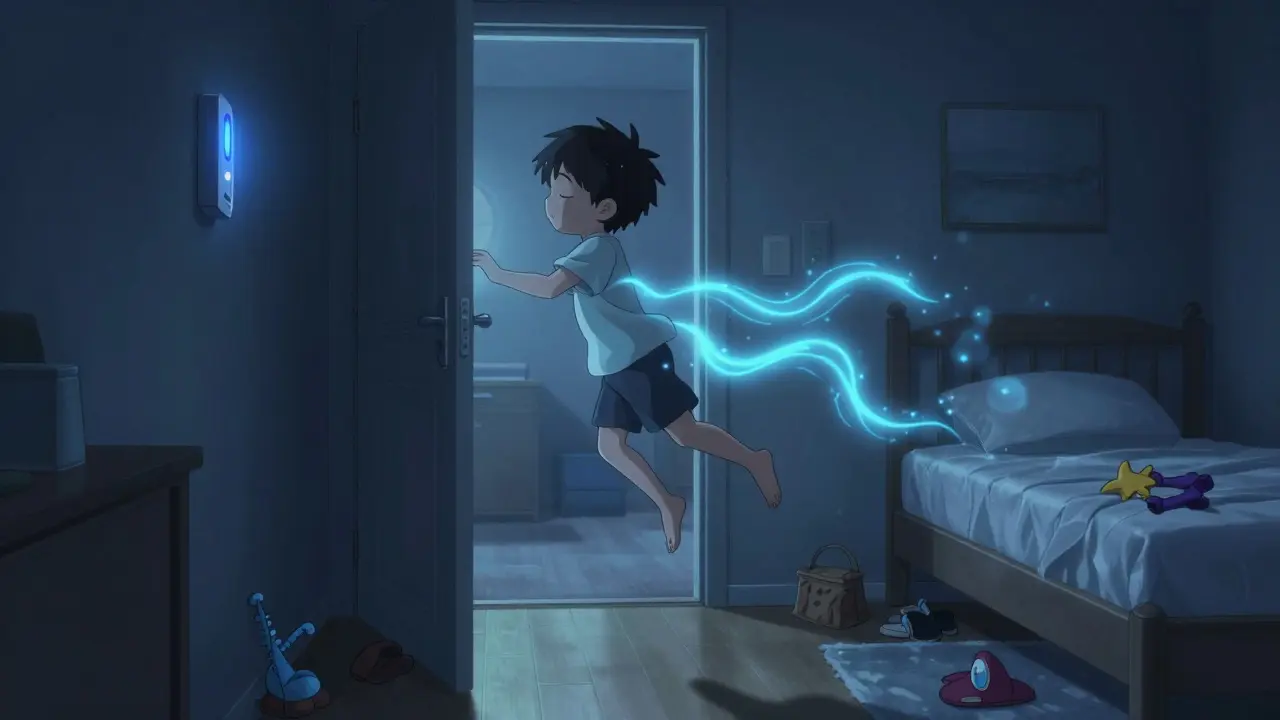
What Exactly Are Sleepwalking and Night Terrors?
When someone gets up in the middle of the night and walks around, or suddenly screams, thrashes, and sweats while still asleep, it’s not a dream-it’s a parasomnia. Sleepwalking and night terrors are two of the most common types, both happening during deep non-REM sleep, usually in the first few hours after falling asleep. Unlike nightmares, where you wake up remembering a scary story, these episodes leave you completely unaware. Most people don’t recall anything the next morning.
These aren’t rare. About 1 in 10 kids sleepwalk at least once, and 1 in 20 have night terrors. For most, it’s a phase that fades by adolescence. But in adults, it’s less common-and often a sign something else is going on, like sleep apnea, stress, or even a neurological issue.
Why Do These Episodes Happen?
The brain doesn’t switch cleanly from deep sleep to wakefulness during a parasomnia episode. Instead, part of the brain wakes up while the rest stays asleep. That’s why someone can sit up, walk, or scream without being truly conscious. It’s not a psychological problem-it’s a neurological glitch in sleep transitions.
Deep slow-wave sleep (stages 3 and 4 of NREM) is when these episodes strike. That’s why they happen early in the night. The brain is under high pressure to recover from the day’s activity, and if sleep is interrupted, fragmented, or too short, that pressure builds up. That’s why sleep deprivation is one of the biggest triggers.
Genetics also play a role. If a parent sleepwalked, their child has a 50% higher chance of doing the same. Recent studies have even found a gene variant (DEC2) linked to inherited sleepwalking patterns. And while kids outgrow it, adults who suddenly start sleepwalking or having night terrors should be checked for sleep apnea, restless legs, or psychiatric conditions-about 1 in 3 adult cases are tied to these.
How Dangerous Are These Episodes?
The biggest risk isn’t the episode itself-it’s what happens during it. People have been known to climb out windows, drive cars, cook with knives, or fall down stairs. In one study, 73% of people with sleepwalking reported at least one injury: cuts from sharp objects, bruises from falls, or even broken bones. Night terrors are less physically active, but the violent thrashing can lead to accidental harm to bed partners.
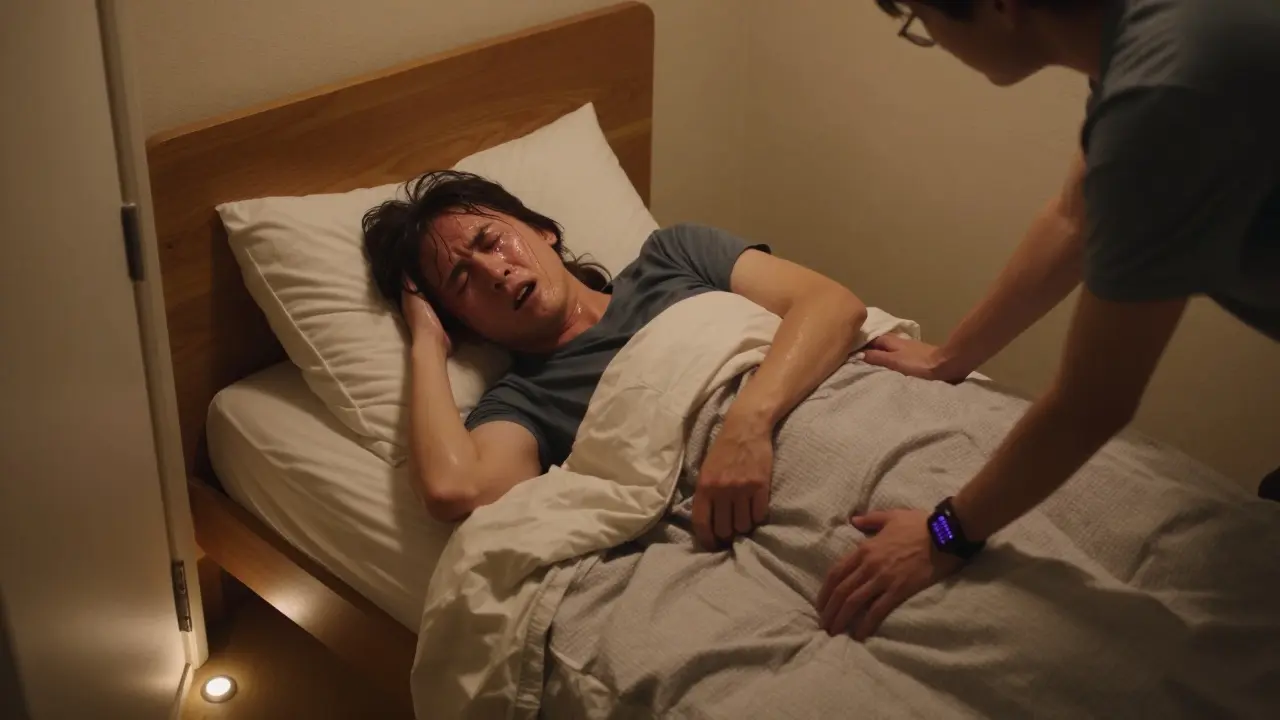
What makes it worse is that trying to wake someone during an episode often makes it worse. They may become confused, aggressive, or disoriented. You can’t reason with someone in the middle of a night terror. They’re not awake. They’re stuck between states.
That’s why safety comes first. No medication, no therapy, no sleep schedule will matter if the person can hurt themselves-or someone else-during an episode.
First Step: Make the Bedroom Safe
Before anything else, secure the environment. This isn’t optional. It’s non-negotiable.
- Install door alarms ($20-$50) that sound when someone opens the bedroom or front door. These are the #1 tool used by families managing sleepwalking.
- Lock all windows and cover them with childproof latches. Even second-floor windows can be dangerous.
- Remove sharp objects, glass tables, and trip hazards from within 10 feet of the bed. That includes shoes, cords, and toys.
- Place the mattress directly on the floor. This reduces fall injuries by 75%.
- If the person leaves the house during episodes, consider installing motion-sensor lights in hallways and stairwells to reduce disorientation.
These steps cost under $100 and can prevent emergency room visits. Most sleep specialists say this is the most effective intervention-no drugs needed.
Behavioral Fixes That Actually Work
Once safety is covered, focus on reducing triggers.
Scheduled Awakenings
This is the most effective method for sleepwalking, especially in children. It works like this: Track when episodes usually happen-say, 1:30 a.m. Wake the person up 15 to 30 minutes before that, at 1:00 a.m., keep them fully awake for 5 minutes, then let them go back to sleep. Do this every night for 7 to 14 days. Studies show 70-80% of cases see a major drop in episodes. It interrupts the deep sleep cycle just enough to prevent the glitch.
Sleep Extension
Most people with parasomnias are chronically sleep-deprived. Adding just 30-60 minutes of sleep per night reduces slow-wave sleep pressure, which lowers episode frequency by 60-65%. That means going to bed earlier-not just sleeping longer on weekends. Consistency matters more than total hours.
Consistent Sleep Schedule
Going to bed and waking up within a 30-minute window every day-even on weekends-cuts episode frequency by 40-50%. The brain thrives on rhythm. Irregular sleep is like throwing a wrench into the sleep machinery.
Relaxation Before Bed
Stress and overstimulation make episodes more likely. A calm bedtime routine helps. No screens for 60 minutes. No caffeine after 2 p.m. A warm bath, light reading, or quiet music can signal the brain it’s time to settle.
When to See a Doctor
You don’t need to see a specialist for every episode. But if any of these happen, it’s time to get evaluated:
- The person starts sleepwalking or having night terrors as an adult (especially after age 20).
- Episodes happen more than twice a week.
- They involve violence, self-harm, or leaving the house.
- Confusion lasts more than 15 minutes after waking.
- There’s suspected sleep-related eating (getting up to eat, often junk food, with no memory).
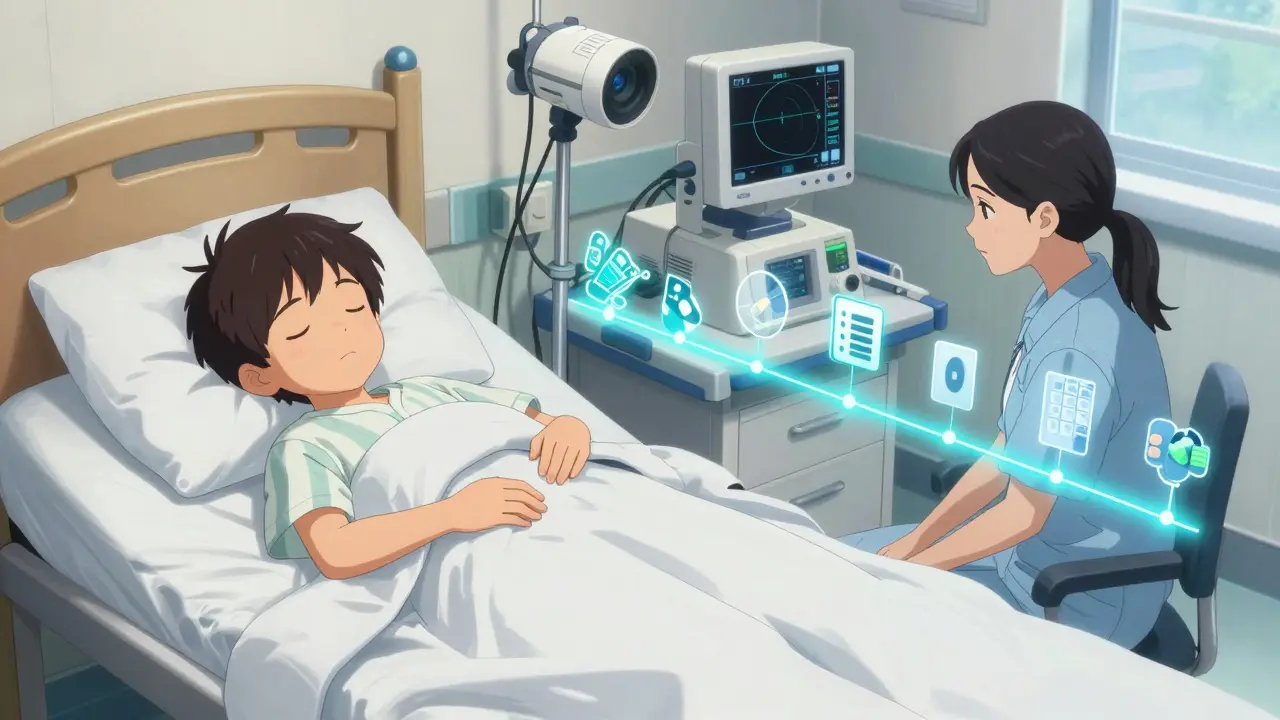
These are red flags. Adult-onset parasomnias can be linked to neurological conditions like Parkinson’s, epilepsy, or brain tumors. A sleep study (polysomnography) with video monitoring is the gold standard for diagnosis.
Medication: Only When Necessary
Medications are a last resort. Only 5-10% of cases need them. But when they’re used, two options stand out:
Clonazepam (Low Dose)
Used off-label for severe cases. A 0.25-0.5 mg dose taken 30-60 minutes before bed reduces night terror frequency by 60-70%. But it carries risks: dependency, drowsiness the next day, and tolerance after 3 months. Not for kids. Not for long-term use.
Melatonin
A safer alternative. Doses of 3-10 mg taken 30 minutes before bed help regulate sleep cycles. Studies show 40-50% reduction in episodes with no dependency risk. Works best when combined with consistent sleep schedules.
Other drugs like antidepressants or anticonvulsants are rarely used and only under specialist supervision.
New Tech and Future Treatments
Technology is catching up. In 2022, the FDA approved the Nightware System-a smartwatch app that detects abnormal heart rate spikes before a night terror starts. It gently vibrates to nudge the brain back into normal sleep, reducing episodes by 35% in trials.
Apps like Sleepio now offer cognitive behavioral therapy for parasomnias (CBT-P) through smartphones. A 2023 study showed a 48% drop in sleepwalking after 8 weeks of guided sessions.
Future drugs like daridorexant, which targets orexin receptors, show promise with fewer side effects than clonazepam. But they’re still in trials.
What Happens Over Time?
Good news: Most kids outgrow it. By age 15, 90% of sleepwalkers and 95% of kids with night terrors stop having episodes. It’s not a lifelong condition for children.
For adults, the outlook is more mixed. With proper safety, sleep hygiene, and occasional therapy, 60-70% see major improvement. But without intervention, episodes can persist-and increase risk of injury, anxiety, and disrupted relationships.
Common Misconceptions
- Myth: You should wake someone during a sleepwalking episode. Truth: It can cause panic, aggression, or confusion. Gently guide them back to bed instead.
- Myth: Night terrors are just bad dreams. Truth: They’re not dreams at all. No memory. No story. Just raw fear and autonomic overload.
- Myth: Only kids get these. Truth: While rare in adults, they’re underdiagnosed. Many are told they’re “anxious” or “psychotic” when it’s actually a sleep disorder.
- Myth: Medication is the best solution. Truth: Behavioral changes and safety measures work better and safer in 90% of cases.
Final Thoughts
Sleepwalking and night terrors aren’t scary because they’re supernatural-they’re scary because they’re silent, unpredictable, and often misunderstood. The good news is, you don’t need a miracle to fix them. You need structure, safety, and consistency.
Start with the door alarm. Add 30 minutes of sleep. Stick to the same bedtime. Track episodes for a month. If things don’t improve, see a sleep specialist. Most people don’t realize how much control they have over their sleep-not by fighting it, but by supporting it.
Can children outgrow sleepwalking and night terrors?
Yes, most do. Around 80% of children who sleepwalk stop by age 10, and 90% of those with night terrors outgrow them by adolescence. These are developmental phases tied to deep sleep patterns that naturally mature with age. No treatment is usually needed unless episodes are frequent or dangerous.
Is sleepwalking the same as REM sleep behavior disorder?
No. Sleepwalking happens during deep non-REM sleep and involves walking, talking, or performing routine tasks with no memory. REM sleep behavior disorder (RBD) happens during REM sleep, involves acting out vivid dreams (like punching or yelling), and usually affects older adults-especially men over 50. RBD is linked to neurological conditions like Parkinson’s, while sleepwalking is not.
Should I wake someone having a night terror?
It’s not recommended. Waking someone during a night terror can make them more confused, scared, or even aggressive. Instead, stay calm, speak softly, and gently guide them back to bed. They’ll usually settle down within a few minutes and won’t remember it later. Safety is more important than trying to wake them.
Can stress cause sleepwalking or night terrors?
Stress doesn’t cause them directly, but it’s a major trigger. High stress, anxiety, or emotional upheaval can increase the frequency and intensity of episodes. That’s why managing stress through routine, relaxation, and good sleep hygiene is a key part of treatment-even more than medication.
Do I need a sleep study to diagnose these conditions?
Not always. For children with typical episodes, a detailed history from parents is often enough. But for adults, frequent episodes, violent behavior, or new-onset symptoms require a sleep study (polysomnography). This test records brain waves, heart rate, and movement to confirm it’s a parasomnia and not something else like seizures or sleep apnea.
Is it safe to take melatonin for sleepwalking or night terrors?
Yes, melatonin is one of the safest options. Doses between 3-10 mg taken 30 minutes before bed help regulate sleep cycles and reduce episode frequency by 40-50%. Unlike prescription drugs, it doesn’t cause dependency or next-day drowsiness. It’s often recommended as a first-line supplement, especially for children and adults avoiding stronger medications.
Releted Post

Caspian Fothergill
Hello, my name is Caspian Fothergill. I am a pharmaceutical expert with years of experience in the industry. My passion for understanding the intricacies of medication and their effects on various diseases has led me to write extensively on the subject. I strive to help people better understand their medications and how they work to improve overall health. Sharing my knowledge and expertise through writing allows me to make a positive impact on the lives of others.
The brain’s failure to transition cleanly between sleep states isn’t just a glitch-it’s a window into how fragile our consciousness really is. We assume we’re in control when we’re asleep, but the truth is, our subconscious is running the show with zero accountability. Sleepwalking and night terrors expose the illusion of safety we build around our own minds. The fact that we can walk, cook, or even drive while completely unaware should terrify us-not because it’s supernatural, but because it’s biological. Our brains are not designed to be this divided. And yet, we treat it like a nuisance to be fixed with alarms and melatonin, when really, we’re ignoring the deeper question: what are we running from that our minds refuse to let us wake up to?
While the article presents a comprehensive overview, it lacks critical engagement with the statistical validity of the cited figures. For instance, the claim that '73% of sleepwalkers reported at least one injury' is not substantiated with a primary source or study citation. Furthermore, the assertion that 'sleep extension reduces episodes by 60-65%' appears to conflate correlation with causation without controlling for confounding variables such as baseline sleep quality or comorbid psychiatric conditions. The absence of peer-reviewed references undermines the credibility of the recommendations, particularly regarding the efficacy of scheduled awakenings in pediatric populations.
They don’t want you to know this, but sleepwalking isn’t a disorder-it’s a signal. The government and Big Pharma are pushing melatonin and clonazepam because they make money off dependency, but the real cause? EMF radiation from smart meters, 5G towers, and Wi-Fi routers is scrambling your brain’s pineal gland. That’s why kids outgrow it-they’re not developing, they’re just getting farther away from the towers. The door alarms? They’re just a distraction. What you need is a Faraday cage around your bed, grounding mats, and a crystal under your pillow tuned to 7.83 Hz-the Earth’s natural frequency. They’ve been covering this up since the 80s. Look up Project MKUltra’s sleep experiments. This isn’t medicine. It’s mind control.
This is one of the most thoughtful, well-researched pieces on parasomnias I’ve encountered in years. The emphasis on environmental safety over pharmacological intervention is not only pragmatic but deeply humane. I especially appreciate the clarification that night terrors are not dreams-it’s a crucial distinction that prevents misdiagnosis. The behavioral strategies outlined, particularly scheduled awakenings and sleep consistency, are grounded in evidence and accessible to most households. It’s refreshing to see a medical topic presented without sensationalism or oversimplification. Thank you for sharing this.
So let me get this straight-you’re telling me the solution to someone climbing out a window at 3 a.m. is to buy a $20 alarm and call it a day? Meanwhile, people are paying $800/hour for therapists to 'process their trauma' because they had a bad childhood, but we’re not even considering that maybe, just maybe, the human brain isn’t meant to function on 5 hours of sleep while scrolling TikTok until 2 a.m.? You want to fix this? Stop pretending you’re a responsible adult. Turn off your phone. Go to bed. Sleep. It’s not rocket science. It’s basic self-respect.
Every time I read something like this, I feel like I’m watching a documentary about the end of the world and everyone’s just arguing about the color of the curtains. We’re talking about people who literally get up and walk while their brain is asleep. And we’re treating it like a plumbing issue-fix the pipes, install the alarm, take the melatonin. But what if this isn’t about sleep? What if it’s about the soul? What if the body is screaming because the mind is buried under a mountain of unprocessed grief, guilt, or existential dread? We’ve turned the human experience into a checklist of symptoms and solutions. We don’t want to sit with the mystery. We want to fix it. And that’s why we’re all still walking in our sleep.
Interesting that the article doesn’t mention how common this is in people with PTSD. My cousin had night terrors after her deployment-only stopped after trauma therapy, not alarms or melatonin. The sleep stuff is just surface-level. The real fix is dealing with what’s haunting you while you’re awake.
Oh wow, so we’re just supposed to believe that a $20 door alarm is the #1 solution? Because clearly, the 100-year-old medical establishment hasn’t thought of that. Let me guess-next they’ll tell us that drinking water cures cancer. Meanwhile, people are dying because they’re not getting the proper neurology workup. You know what’s more dangerous than sleepwalking? Believing a blog post written by someone who probably Googled ‘sleep disorders’ last night.
My grandma used to sleepwalk and she’d whisper to herself in a language no one in the family recognized. We thought it was dementia. Turns out, her mother did the same thing. Maybe it’s not just genetics-it’s ancestral memory. Like the brain is remembering something it’s not supposed to forget. I don’t know if science can explain that. But I know I stopped sleeping with the lights off after I started dreaming in her voice. 🌑
My kid sleepwalks and we did the scheduled awakenings and it worked for like two weeks then stopped. I think it’s just random. Also I don’t trust melatonin because I read online it’s made from sheep brains?? I don’t even know if that’s true but now I’m scared to give it to her. Also why do people say don’t wake them? I woke my brother once and he screamed at me for like 10 minutes then cried. I still feel bad.
I used to sleepwalk as a teen. I once made a sandwich and ate it in the kitchen while fully asleep. Didn’t remember a thing. My mom found me standing there with peanut butter on my pajamas. I thought it was funny until I realized I’d left the stove on. After that, we just locked the kitchen door. No alarms, no meds. Just common sense. And sleep. So much sleep. I haven’t done it since I was 19. I think it was just my body begging me to rest.