

Macrolide Arrhythmia Risk Calculator
When you take an antibiotic like azithromycin for a sinus infection or clarithromycin for pneumonia, you’re trusting it to kill bacteria-not hurt your heart. But for some people, these common drugs can quietly disrupt the heart’s electrical rhythm, leading to a dangerous condition called QT prolongation. It’s not common, but when it happens, it can trigger a life-threatening arrhythmia called Torsades de Pointes. And the risk isn’t the same for everyone-or for every macrolide antibiotic.
What Are Macrolide Antibiotics?
Macrolide antibiotics are a group of drugs used for decades to treat bacterial infections like strep throat, bronchitis, and pneumonia. The most common ones are erythromycin, clarithromycin, and azithromycin. They’re popular because they work well against many bacteria, have fewer side effects than some other antibiotics, and are often prescribed as a single daily dose. Azithromycin, in particular, became a go-to because it’s taken for just five days and causes less stomach upset than older versions.
But behind their convenience lies a hidden risk: these drugs can block a specific potassium channel in heart cells called Ikr, which is coded by the hERG gene. This channel helps the heart reset after each beat. When it’s blocked, the heart takes longer to recharge between beats-and that delay shows up on an ECG as a longer QT interval.
How QT Prolongation Leads to Arrhythmias
The heart’s rhythm depends on precise timing. After each contraction, heart cells must repolarize-reset their electrical charge-so they’re ready for the next beat. The QT interval on an ECG measures how long this reset takes. When it’s too long, the heart becomes electrically unstable.
That’s when things get dangerous. A prolonged QT can lead to early afterdepolarizations-tiny, abnormal electrical sparks in heart muscle cells. These can trigger Torsades de Pointes, a type of ventricular tachycardia where the heart quivers instead of pumping. It can resolve on its own… or it can degenerate into ventricular fibrillation and cause sudden death.
What makes this especially tricky is that the effect isn’t the same across all heart tissue. Studies show macrolides primarily affect the M-cells in the middle layer of the heart wall, while the outer and inner layers repolarize normally. This creates a mismatch-called transmural dispersion of repolarization-that’s the perfect setup for TdP to start.
Not All Macrolides Are Created Equal
Many assume azithromycin is the safest macrolide because it’s the most commonly prescribed. That’s true-but not because it’s risk-free. The truth is more nuanced.
- Clarithromycin has the strongest effect on the Ikr channel and also blocks the liver enzyme CYP3A4. This means it can raise levels of other drugs that prolong QT, like statins or antiarrhythmics, making the risk even higher. It carries a black box warning from the FDA for this reason.
- Erythromycin is a weaker blocker of Ikr, but it causes severe nausea and vomiting in many people. That can lead to low potassium (hypokalemia), which independently increases QT prolongation risk.
- Azithromycin has the mildest effect on Ikr and doesn’t interfere much with liver enzymes. But large studies still show it carries a measurable risk. A 2012 study of over 1.3 million patients found azithromycin was linked to 2.85 extra cardiovascular deaths per 1,000 courses compared to amoxicillin-mostly in the first five days of use.
Even though azithromycin accounts for 65% of all macrolide prescriptions in the U.S., its labeling still includes a warning about QT prolongation. The FDA has documented cases of TdP linked to azithromycin, even in people without prior heart conditions.
Who’s at Highest Risk?
For most healthy people, the chance of developing TdP from a macrolide is extremely low-less than 1 in 10,000 prescriptions. But for others, the risk jumps dramatically.
Research from the NIH in 2025 identifies six major risk factors:
- Female sex: Women make up 68% of all reported TdP cases from macrolides.
- Age over 65: Risk more than doubles.
- Baseline QTc over 450 ms: That’s a 4.7-fold increase in risk.
- Other QT-prolonging drugs: Taking even one additional drug that affects the QT interval (like certain antidepressants or antifungals) raises the risk by 1.8 times per drug.
- Low potassium or magnesium: Hypokalemia increases risk by over three times.
- Heart failure or structural heart disease: This increases TdP risk by more than five times.
There’s also a hidden layer: subclinical long QT syndrome. About 5-20% of people who develop TdP after taking these antibiotics have a genetic mutation they didn’t know about. Their QT interval looks normal on a baseline ECG-but their heart’s repolarization reserve is already stretched thin. Add a macrolide, and the system fails.
What Should Doctors and Patients Do?
Guidelines from the American College of Cardiology and the Infectious Diseases Society of America are clear: don’t ignore the risk. Here’s what works in practice:
- Check baseline ECG if you have two or more risk factors. This is especially important for older adults, women, or anyone on multiple medications.
- Monitor QTc during treatment. If it goes above 470 ms in men or 480 ms in women-or increases by more than 60 ms from baseline-stop the drug.
- Avoid macrolides entirely if you’ve had TdP before, have congenital long QT syndrome, or are taking drugs like quinidine, amiodarone, or sotalol.
- Don’t combine macrolides with hydroxychloroquine or other QT-prolonging agents. During the pandemic, this combo pushed QTc up by over 26 ms on average-enough to trigger arrhythmias in vulnerable patients.
Some hospitals now use the Macrolide Arrhythmia Risk Calculator (MARC), a tool developed in 2024 that uses 12 clinical factors to estimate an individual’s TdP risk with 89% accuracy. It’s not perfect, but it helps doctors make smarter choices.

The Bigger Picture: Why This Matters
The number of macrolide prescriptions in the U.S. dropped by nearly 19% between 2010 and 2020-not because they’re less effective, but because awareness grew. Clarithromycin use fell 23.5% among Medicare patients after the AHA’s 2020 warning. Prescribers now think twice before reaching for a macrolide.
Still, these drugs remain widely used because they’re effective and convenient. The challenge is balancing benefit and risk. For a young, healthy person with a simple infection, the odds are overwhelmingly in their favor. But for someone with heart disease, kidney problems, or on multiple meds? The risk isn’t theoretical-it’s real.
There’s also progress on the horizon. Researchers are testing new macrolide derivatives like solithromycin, designed to be less toxic to the heart. Early trials showed 78% less Ikr blockade than clarithromycin. Unfortunately, development was paused due to liver side effects. Now, scientists are looking at pharmacogenomics-identifying people with hERG gene variants that make them extra sensitive. Preliminary data suggests 15% of the population carries these variants, putting them at 4.2 times higher risk.
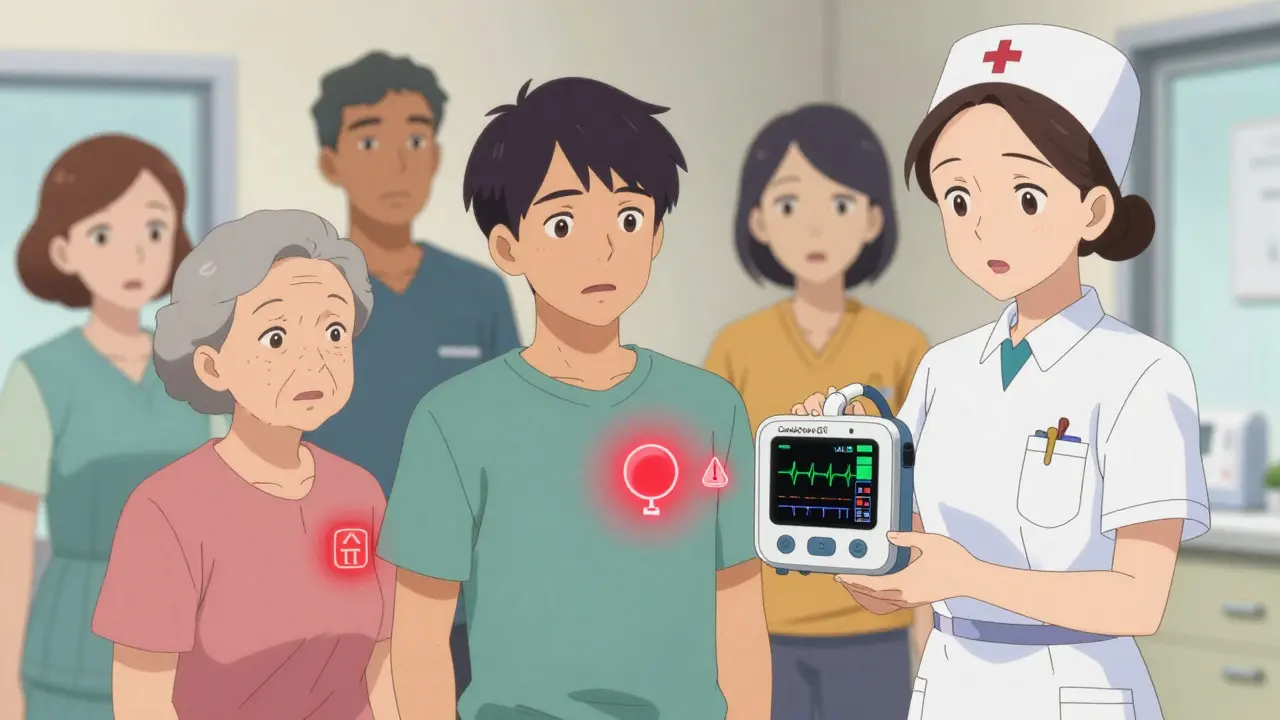
And new tools are helping. The FDA approved a point-of-care ECG device in 2023 called the CardioCare QT Monitor. It gives accurate QTc readings in under a minute, right in the doctor’s office. No more waiting for lab results.
What You Should Remember
You don’t need to avoid macrolides altogether. But you do need to understand that they’re not risk-free. If you’re prescribed one:
- Ask if you have any risk factors-especially if you’re over 65, female, or on other medications.
- Know the signs of a dangerous arrhythmia: dizziness, fainting, palpitations, or sudden shortness of breath.
- Don’t skip electrolyte checks if you’re vomiting or taking diuretics.
- Don’t assume azithromycin is completely safe just because it’s the most common.
Antibiotics save lives. But like all powerful tools, they come with trade-offs. The key isn’t fear-it’s awareness. And for patients and doctors alike, that awareness can mean the difference between a quick recovery and a cardiac emergency.
Releted Post


Caspian Fothergill
Hello, my name is Caspian Fothergill. I am a pharmaceutical expert with years of experience in the industry. My passion for understanding the intricacies of medication and their effects on various diseases has led me to write extensively on the subject. I strive to help people better understand their medications and how they work to improve overall health. Sharing my knowledge and expertise through writing allows me to make a positive impact on the lives of others.
Man, I never realized how sneaky these antibiotics could be. I took azithromycin last year for a bad cough and felt fine-until I started getting dizzy. Thought it was dehydration. Turns out my QTc was up to 485. Scary stuff. Glad I didn’t ignore it.
Doctors treat these like candy, but they’re basically playing Russian roulette with your heart if you’ve got any risk factors. Even ‘safe’ ones like azithro.
Also, why is no one talking about how often these are prescribed for viral infections? Like… it’s a cold. You don’t need an antibiotic. But sure, here’s a 5-day course. Thanks, I guess.
Oh great. Another ‘big pharma is hiding the truth’ post. Newsflash: antibiotics aren’t magic. They’re chemicals. And chemicals have side effects. You think the FDA doesn’t know this? They’ve been warning about QT prolongation since the 90s.
Stop acting like this is some new conspiracy. People die from untreated pneumonia. Do you want them to die slowly from bacterial rot instead of fast from an arrhythmia? Choose your poison.
Also, I’m a nurse. I’ve seen TdP. It’s ugly. But I’ve also seen people who didn’t get antibiotics die. So don’t scare people into avoiding life-saving meds because you read one Reddit post.
This is one of those topics where the science is rock-solid, but the public messaging is garbage. We’ve got a generation of patients who think ‘natural’ means ‘safe’ and ‘prescribed’ means ‘risk-free.’
The real win here isn’t avoiding macrolides-it’s better screening. Baseline ECGs for high-risk folks? Easy. Cheap. Life-saving.
And honestly? If your doctor doesn’t ask about your meds, your electrolytes, or your family history before prescribing azithro… find a new doctor. Seriously.
Oh honey, you think this is bad? In South Africa, we don’t even have ECG machines in half the clinics. People get azithromycin for ‘fever’ and die in their beds because no one knew to check QT.
And you know what’s worse? The WHO still lists macrolides as ‘essential’-because they’re cheap. So we’re forced to gamble with people’s lives because we can’t afford better alternatives.
Meanwhile, Americans are debating whether azithro is ‘safe enough.’ Wake up. Privilege is showing.
There’s a deeper metaphysical layer here: we treat the body as a machine with discrete, isolated systems-electrical, chemical, mechanical-when in reality, it’s a dynamic, emergent system. The QT interval isn’t just a number on a screen; it’s the audible echo of cellular autonomy, a heartbeat’s whisper of homeostatic tension.
When we block hERG channels, we’re not just interfering with ion flow-we’re disrupting the temporal rhythm of life itself. The heart doesn’t ‘reset’ like a computer. It *remembers*. And sometimes, memory becomes a fatal loop.
Pharmacogenomics might be the key, but only if we stop reducing patients to risk factors and start seeing them as unique biological symphonies.
Of course you’re not surprised. People take antibiotics like vitamins. They pop azithromycin like it’s a vitamin C tablet because they saw a TikTok about ‘boosting immunity.’
And then they’re shocked when they get a lethal arrhythmia. You don’t get to be ignorant and then act like the system failed you. This is basic pharmacology. You don’t mix drugs with QT-prolonging effects unless you’re a medical resident doing a case study.
Blame the people who prescribe without thinking. Not the science.
So let me get this straight: azithromycin = low risk, clarithro = high risk, erythromycin = nausea + low potassium = double whammy.
And yet, 65% of prescriptions are azithro? That’s like saying ‘this car has the weakest brakes, but it’s the most popular because it’s shiny.’
Also, did anyone else notice the 2012 study showed 2.85 extra deaths per 1,000 courses? That’s not ‘rare.’ That’s 1 in 350. If you’re on statins and a beta-blocker? You’re playing Jenga with your heart.
And solithromycin got axed for liver issues? Classic. Fix one problem, break another. Pharma’s a game of whack-a-mole.
Wait, so the FDA has documented TdP cases from azithromycin even in healthy people? And you’re telling me we’re still prescribing it like it’s Advil?
My aunt took it for bronchitis, had palpitations, went to the ER, and they said ‘it’s probably anxiety.’ She ended up in the ICU. No ECG was done until she coded.
Why is this not standard protocol? Why is it still on the ‘first-line’ list? This isn’t science-it’s inertia.
Thank you for writing this. In Nigeria, we use azithromycin for everything-malaria, cough, even fever without diagnosis. No ECG. No labs. Just pills.
People die. We don’t talk about it. But this? This is important. I will share with my community.
❤️
Oh wow. A 19% drop in prescriptions since 2010? Guess what? That’s because people finally stopped taking antibiotics for their ‘allergies’ and ‘bad vibes.’
Meanwhile, the same people who panic about QT prolongation are still drinking 5 energy drinks a day and taking Zyrtec with their morning coffee. But hey, at least they didn’t take a ‘dangerous’ antibiotic.
Reality check: your phone has more sensors than your doctor’s office. Use them.
Just want to say: this is one of the most balanced, well-referenced pieces on this topic I’ve ever seen. Seriously. The MARC calculator? The pharmacogenomics angle? The point-of-care ECG device? All critical.
It’s not about fear. It’s about informed consent. And if your doctor can’t explain the risk-benefit ratio of azithro in 30 seconds, you’re not getting good care.
Thank you for writing this. I’ll be sharing it with my med student niece.
🙏
So let me get this straight-someone wrote a 2,000-word essay on why azithromycin might kill you, but didn’t mention that you can just use doxycycline or amoxicillin instead? How is this not the headline?
Macrolides are NOT the only option. We’ve had alternatives for decades. This isn’t a ‘risk management’ problem. It’s a laziness problem.
Stop glorifying convenience. It’s killing people.
QT prolongation = bad. Azithro = risky. Duh. Also, hERG = bad. Stop taking drugs. Also, why are you even reading this? Go outside. Or better yet, go to a doctor who knows what they’re doing. 🤦♀️