
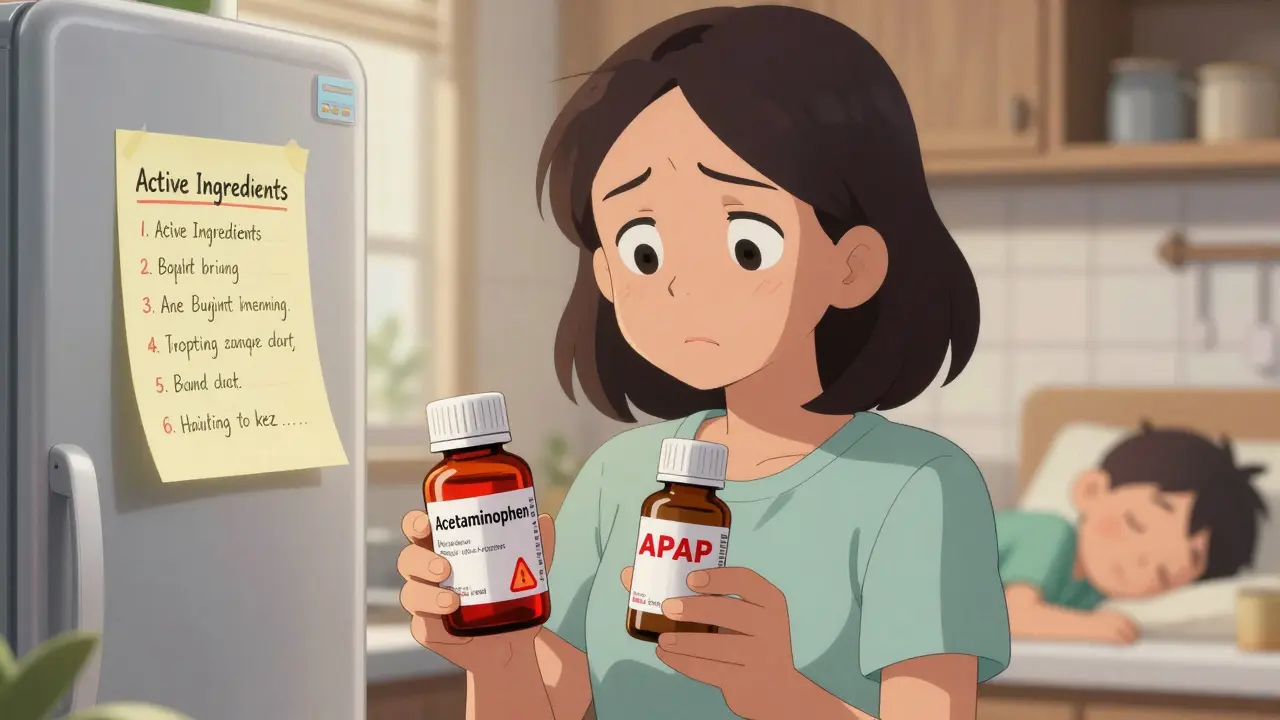
Every year, thousands of children end up in emergency rooms because their parents gave them too much of a medicine - not because they meant to, but because they didn’t know they were giving the same ingredient twice. It’s not rare. It’s not unusual. It’s happening in homes across the country, often with medications bought over the counter and trusted as harmless. The truth? Active ingredients are the hidden danger. And checking them isn’t optional - it’s life-saving.
Why Double Dosing Happens
Parents aren’t careless. They’re tired. They’re worried. They’re trying to help. A child has a fever, a runny nose, and a cough. So they grab the fever reducer. Then the cold medicine. Then the cough syrup. All seem like separate fixes. But here’s the catch: most of them contain the same active ingredient - usually acetaminophen or ibuprofen. And giving two of those together? That’s not two treatments. That’s an overdose. The numbers don’t lie. In 2016, a study in Pediatrics found that 21% of parents had accidentally doubled a child’s dose of medicine. The American Association of Poison Control Centers says medication errors cause about 10% of all pediatric poisonings. And acetaminophen? It’s behind nearly half of all acute liver failures in kids under six. That’s not a statistic. That’s a child who could’ve been saved.The Most Dangerous Ingredients
Not all medications are equal. Some have a very narrow safety window - meaning the difference between the right dose and a harmful one is small. Here are the top offenders:- Acetaminophen (also called paracetamol, APAP, or N-acetyl-p-aminophenol): Found in Tylenol, Children’s NyQuil, Theraflu, Vicks cough syrups, and dozens of other brands. Even a little extra can damage the liver.
- Ibuprofen: Sold as Advil, Motrin, and many store brands. Too much can cause stomach bleeding or kidney damage.
- Diphenhydramine: An antihistamine in Benadryl, Children’s Zyrtec, and many nighttime cold formulas. Overdose causes extreme drowsiness, confusion, or even seizures.
- Decongestants like pseudoephedrine or phenylephrine: Can spike heart rate and blood pressure in young children.
How to Check Active Ingredients - Step by Step
You don’t need to be a pharmacist. You just need to know where to look. Here’s how to do it every single time:- Look at the "Active Ingredients" section - not the brand name. It’s always listed right under "Drug Facts" on the label. That’s the law. If you can’t find it, don’t give it.
- Write it down. Use a sticky note, phone note, or a simple checklist. Write the ingredient name, the dose (e.g., 160 mg per 5 mL), and the time you gave it.
- Compare before giving any new medicine. Even if it’s a different brand, different color, different flavor. If it says "acetaminophen," and you gave Tylenol 4 hours ago - stop.
- Never mix fever reducers unless directed. The American Academy of Family Physicians warns that alternating acetaminophen and ibuprofen increases double dosing risk by 47%. Stick to one unless your doctor says otherwise.
- Use the right measuring tool. Never use a kitchen spoon. The FDA says household spoons can vary by up to 200%. Always use the dropper, syringe, or cup that came with the bottle.
Real Stories, Real Risks
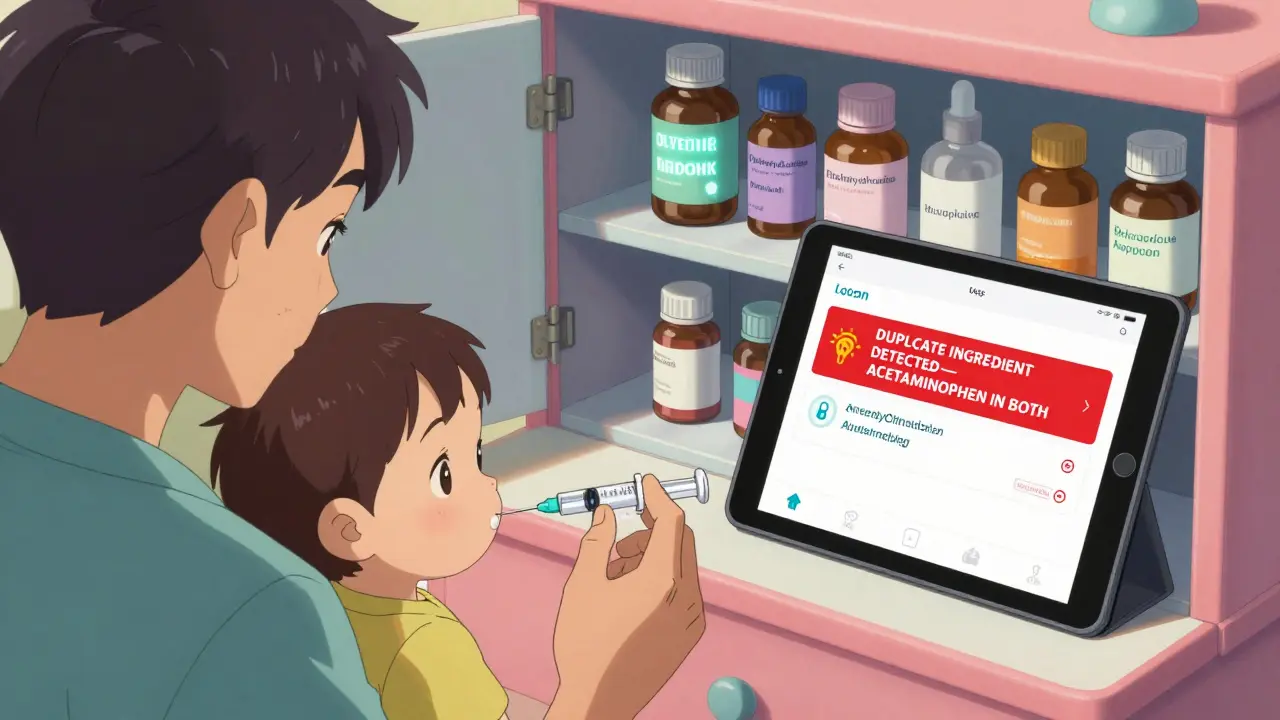
One mom on Reddit shared how her 3-year-old ended up in the ER after two caregivers gave him Benadryl - one for allergies, the other for sleep - without knowing both contained diphenhydramine. He was so drowsy he couldn’t sit up. Another father in Minnesota accidentally gave his 2-year-old both a cold medicine and a nighttime cough syrup. Both had acetaminophen. He didn’t realize until the next morning, when his child vomited and looked pale. He called Poison Control. They told him to go to the hospital. He did. His son got N-acetylcysteine, the antidote for acetaminophen overdose. He survived. But he didn’t need to. A 2022 survey of 1,200 parents found that 42% had accidentally double dosed their child at least once. Most said they didn’t think it mattered - "it’s just a cold medicine." But cold medicine isn’t harmless. It’s a chemical. And kids aren’t small adults. Their bodies process drugs differently. A 10% overdose in a child under two can double the risk of serious side effects.What Works - Real Solutions From Real Families
The good news? This is preventable. And simple changes make a huge difference.- One person handles all meds. If mom gives the fever reducer, dad doesn’t give the cough syrup. Assign one adult to manage all doses. This cuts communication errors - which cause 38% of double dosing incidents.
- Create a medication map. One dad on BabyCenter made a chart of every medicine in his house: brand, active ingredient, strength, and last time given. He kept it on the fridge. Within six months, his family had zero dosing errors.
- Use a medication app. Apps like Medisafe or Round Health send alerts when a dose is due and warn you if you’re about to give a duplicate ingredient. A 2023 Consumer Reports review found they reduce risk by 52%. The catch? Only 28% of parents use them.
- Ask your pharmacist. When you pick up a new medicine, ask: "Is this safe to give with what else we’re using?" Pharmacists now offer printed dosing charts with active ingredients highlighted. 92% of them do it.
What’s Changing - And What You Should Know
The system is slowly catching up. In January 2024, the American Academy of Pediatrics launched "Know Your Ingredients," a campaign with standardized icons on medicine packaging to make active ingredients easier to spot. By December 2025, the FDA will require all pediatric OTC medicines to list active ingredients in a bold, uniform format. Some companies are adding QR codes to labels that link to ingredient comparisons. Amazon Pharmacy now has a "MedCheck" feature that scans your purchases and warns you if you’re buying something with the same active ingredient as something you already bought. In its first six months, it prevented an estimated 12,000 potential overdoses. But here’s the problem: labeling is still messy. Acetaminophen shows up as APAP, paracetamol, N-acetyl-p-aminophenol, or just "pain reliever." And 68% of parents don’t realize these are all the same thing.What You Can Do Today
You don’t need to wait for better labels or new apps. You can start now:- Go to your medicine cabinet. Pull out every children’s OTC medicine.
- Write down every active ingredient on a piece of paper.
- Group them by name - not brand.
- Throw out anything you don’t need.
- Keep only one product per active ingredient.
- Put your list on the fridge.
The CDC says proper active ingredient checking could prevent up to 67% of pediatric medication overdoses from combination products. That’s not a guess. That’s data. And it’s not about being perfect. It’s about being aware. One check. One question. One moment of pause. That’s all it takes.
What should I do if I think I gave my child too much medicine?
Call Poison Control immediately at 1-800-222-1222. Do not wait for symptoms. Do not try to make your child vomit. Have the medicine bottle with you when you call. They’ll tell you whether to go to the ER, monitor at home, or take other steps. Time matters - especially with acetaminophen or ADHD medications.
Can I give my child Tylenol and a cold medicine at the same time?
Only if the cold medicine doesn’t contain acetaminophen. Most do. Always check the "Active Ingredients" section. If it says "acetaminophen," "APAP," or "paracetamol," don’t give Tylenol on top of it. Even if the cold medicine says "for kids," it still has the same drug. You’re not helping - you’re risking liver damage.
Why do some medicines have different names for the same ingredient?
Manufacturers use different names to make products seem unique. Acetaminophen is also called paracetamol, APAP, or N-acetyl-p-aminophenol. Ibuprofen might be listed as "ibuprofen sodium" or "NSAID." These aren’t different drugs - they’re the same chemical. Parents get tricked by the labels. Always look for the ingredient, not the brand.
Is it safe to alternate acetaminophen and ibuprofen for fever?
The American Academy of Family Physicians says no - not for children under 3. It increases the risk of double dosing by 47%. It also makes it harder to track what you’ve given. Stick to one medicine unless your pediatrician specifically recommends alternating - and even then, write it down.
How do I know if I’m using the right measuring tool?
Use only the tool that came with the medicine - a syringe, dropper, or cup marked in milliliters (mL). Never use a kitchen teaspoon or tablespoon. A household teaspoon can hold anywhere from 2.5 mL to 7.5 mL. That’s a 200% variation. The FDA says this is one of the top reasons kids get overdosed.
Are liquid medicines safer than pills for kids?
Liquid medicines are easier to dose by weight, but they’re also more dangerous if measured wrong. A child’s dose is calculated precisely by pounds or kilograms. A small error - even 1 mL too much - can be harmful. That’s why using the right tool and checking the concentration (mg per mL) is critical. Pills can be easier to control if your child can swallow them, but always follow weight-based dosing.
Releted Post

Caspian Fothergill
Hello, my name is Caspian Fothergill. I am a pharmaceutical expert with years of experience in the industry. My passion for understanding the intricacies of medication and their effects on various diseases has led me to write extensively on the subject. I strive to help people better understand their medications and how they work to improve overall health. Sharing my knowledge and expertise through writing allows me to make a positive impact on the lives of others.
Just did this last week after my niece got sick. I pulled out every bottle, wrote down every active ingredient, and threw out three duplicates. Took 12 minutes. I feel like a superhero now. Seriously, if you’re reading this and haven’t done it yet - stop. Go do it. Right now. Your kid’s liver will thank you.
Also, side note: I started labeling the bottles with colored tape - red for acetaminophen, blue for ibuprofen. Simple. Visual. Works.
Don’t wait for an ER visit. This isn’t theoretical. It’s real.
lol i just gave my kid tylenol then a cold med n i thought ‘wait… is this the same?’ then i checked and yep. panic mode. called poison control they were chill as hell. told me to watch him for 2 hrs. he’s fine. but now i have a sticky note on my fridge that says ‘CHECK THE INGREDIENTS DUMMY’
also why do they call it APAP? who thought that was a good idea?
As a pediatric nurse, I’ve seen this too many times. Parents aren’t negligent - they’re overwhelmed. The system is designed to confuse you. Brand names, different packaging, fake ‘natural’ claims, hidden abbreviations. It’s predatory. But here’s the good news: you don’t need to be an expert. You just need to pause. Read the small print. Write it down. That’s it.
My hospital started giving out laminated cards with the top 5 active ingredients and their aliases. Parents love them. I hand them out like candy. If you want one, DM me. I’ll mail you one free.
Small effort. Big impact.
Let’s deconstruct the epistemology of pharmaceutical labeling, shall we? The very notion that a child’s life hinges on deciphering corporate obfuscation - APAP vs. paracetamol vs. N-acetyl-p-aminophenol - is a grotesque satire of modern capitalism. We’ve outsourced parental vigilance to a labyrinth of trademarked euphemisms while corporations profit from the very confusion they engineered.
The FDA’s ‘standardized icons’? A performative gesture. A Band-Aid on a hemorrhage. Real reform would require dismantling the patent-driven incentive to obscure active ingredients. But no - we’ll keep slapping QR codes on bottles like digital talismans while the liver failures stack up like dominos.
So yes, check your meds. But know this: the system is rigged. Your diligence is noble. It’s also a symptom of a broken world.
Y’all this changed my life. I used to just grab whatever looked like it might help. Now I keep a little notebook on the counter. I write the time, the med, the ingredient, and the dose. My 4-year-old had a fever last week - I checked my list before giving anything. Turned out I already gave him something with acetaminophen. I skipped it. He slept better. I felt like a genius.
Also, the Medisafe app? Game changer. It even reminds me when to wash the syringe. Who knew parenting could feel this organized?
Do the thing. It’s not hard. You got this.
OMG I JUST REALIZED I GAVE MY KID BENADRYL AND ZYRTEC ON THE SAME DAY 😭😭😭 I THOUGHT THEY WERE DIFFERENT BECAUSE ONE WAS BLUE AND ONE WAS PINK 😭😭😭 I’M SUCH A BAD MOM 😭😭😭
HE’S FINE THOUGH?? I THINK?? I CALLED POISON CONTROL THEY SAID HE’D BE OKAY BUT NOW I’M SCARED TO SLEEP 😭😭😭
ANYONE ELSE DO THIS?? I NEED TO KNOW IM NOT ALONE 😭
PS: I JUST BURNED MY MEDICINE CABINET. NO MORE CHEMICALS. JUST HERBS. AND CRYING.
😭😭😭
People still need to be told this? It’s 2024. We have smartphones. We have apps. We have access to pharmacists. And yet we’re still giving kids multiple cold medicines like it’s a buffet? This isn’t ignorance - it’s laziness wrapped in parental guilt. You think you’re helping? You’re just playing Russian roulette with your kid’s liver.
And don’t even get me started on ‘natural’ remedies that still contain acetaminophen. That’s not natural. That’s deceit.
Stop making excuses. Read the label. Or don’t give it at all.
I made a little chart on my phone with all the meds we use. I put the active ingredients in bold. I share it with my partner and my mom. We all check before giving anything. It’s so simple. I used to think I was being overcautious. Now I think I was being reckless.
Thanks for the reminder. I printed it out and taped it to the fridge.
Small steps.
I’m not a parent but I babysit a lot and this post made me cry. Not because it’s scary - because it’s so fixable. Just take 15 minutes. Write it down. Throw out the extras. It’s not about being perfect. It’s about being present.
Thank you for writing this. I’m sharing it with everyone I know who has kids. Seriously - everyone.
While the practical advice presented is commendable and aligns with CDC and AAP guidelines, a critical methodological flaw persists in the statistical interpretation of the 2022 survey referenced: the self-reported nature of parental behavior introduces significant recall bias. Furthermore, the assertion that 67% of overdoses are preventable through ingredient checking assumes perfect adherence, which is empirically unsupported by behavioral economics literature on health compliance. A more robust intervention would require systemic redesign - not merely individual vigilance - particularly given the documented cognitive load imposed on caregivers by polypharmacy in pediatric populations. The current model places undue burden on the least resourced demographic while systemic accountability remains unaddressed.