
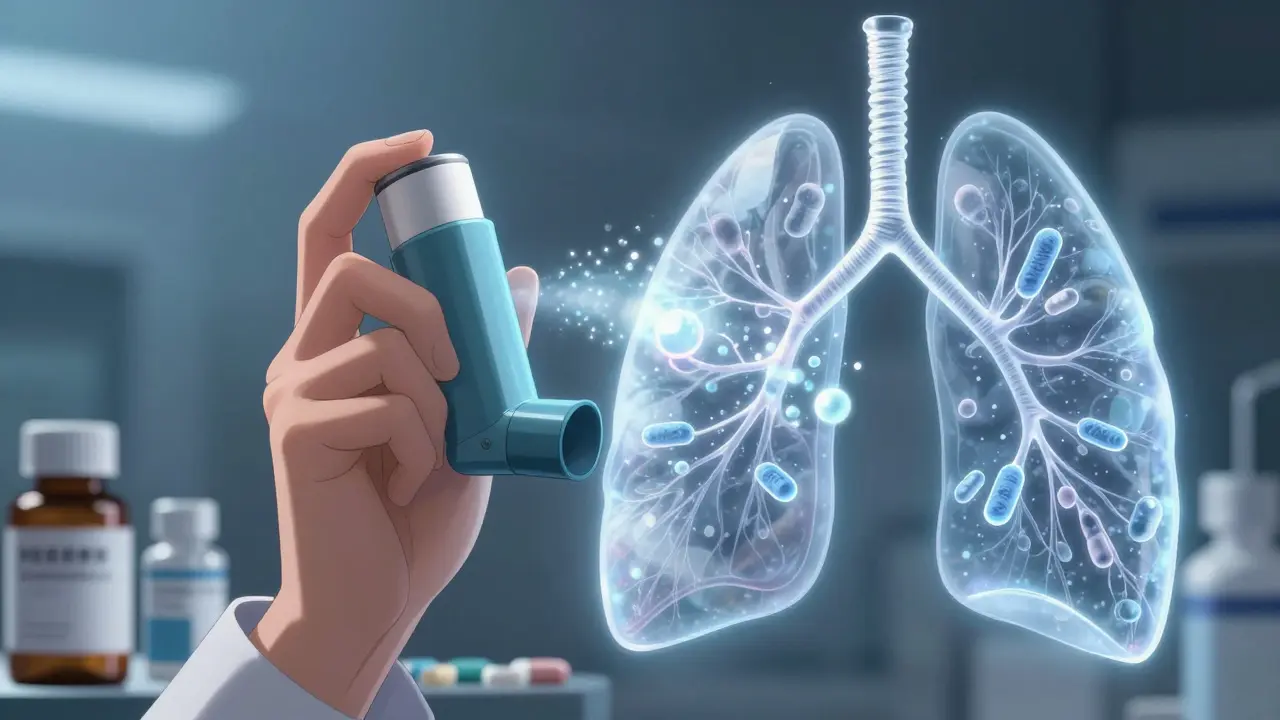
When you pick up a generic drug at the pharmacy, you expect it to work just like the brand-name version. For most pills - like statins or blood pressure meds - that’s true. But for a growing number of complex medications, proving they’re equivalent isn’t just difficult. It’s often a scientific marathon with no clear finish line. These are the complex generics: drugs that don’t fit the old rules. They’re not your average tablet. They’re inhalers that must deliver particles to the exact depth of your lungs. They’re creams that need to penetrate skin layers without entering your bloodstream. They’re injectables with nanoparticles that change behavior if the manufacturing temperature shifts by two degrees. And right now, only about 10-15% of them ever make it to market.
What Makes a Generic "Complex"?
The term "complex generic" isn’t just marketing jargon. It’s a regulatory classification used by the FDA to describe products that can’t be evaluated using the standard blood-test method. Traditional bioequivalence studies measure how fast and how much of the drug enters your bloodstream. That works for pills you swallow - the drug gets absorbed, circulates, and acts systemically. But for many modern treatments, that’s irrelevant.
Complex generics fall into five main categories:
- Complex active ingredients: Peptides, proteins, or natural extracts that break down easily or have multiple forms.
- Complex formulations: Liposomes, emulsions, gels, suspensions, and nanoparticles that change how the drug moves through the body.
- Complex delivery routes: Topical creams, eye drops, ear drops, and inhalers where the drug must act locally, not systemically.
- Complex dosage forms: Extended-release injectables, transdermal patches, and metered-dose inhalers.
- Drug-device combinations: Inhalers with precise spray patterns, auto-injectors with calibrated doses, or patches with controlled release mechanisms.
Take a topical corticosteroid cream for eczema. The goal isn’t to get the drug into your blood. It’s to get it into the top layers of your skin - just enough to reduce inflammation, but not so much that it causes side effects. How do you prove a generic cream does that as well as the brand? You can’t just measure blood levels. You need to measure skin penetration, drug distribution, and even how the cream feels when applied. That’s not a simple lab test. It’s a multi-step scientific puzzle.
The Bioequivalence Problem: Can’t Measure What You Can’t See
The FDA defines bioequivalence as "the absence of a significant difference in the rate and extent to which the active ingredient becomes available at the site of drug action." For a standard pill, "site of action" is the bloodstream. For an asthma inhaler? It’s the lining of your airways. For a psoriasis ointment? It’s the epidermis. And right now, we don’t have reliable, standardized ways to measure drug levels in those places.
For traditional drugs, bioequivalence is proven with two numbers: AUC (area under the curve) and Cmax (peak concentration). Both must fall within 80%-125% of the brand-name drug. Simple. Clear. Repeatable. But for inhaled drugs, those numbers mean nothing. You can’t stick a needle in someone’s lung to sample the drug concentration. You can’t cut off a patch of skin to test how much medicine soaked in. So regulators and manufacturers are stuck.
Instead, they rely on surrogate measures: particle size in inhalers, spreadability in creams, viscosity in gels. But these are indirect. A generic inhaler might have the same particle size as the brand, but if the spray duration is off by 0.1 seconds, the drug lands in the wrong part of the lung. That small difference can mean less effectiveness - or more side effects. And right now, there’s no global standard for testing spray duration. The FDA has one method. The EMA has another. Manufacturers have to run two separate studies just to get approval in both markets.
The Reverse-Engineering Nightmare
One of the biggest hurdles isn’t science - it’s secrecy. Generic companies don’t get the recipe. They don’t get the manufacturing flowchart. They get a product on the shelf and have to figure out how it works. This is called "de-formulation." It’s like trying to rebuild a Ferrari by only driving it and analyzing the exhaust.
Take a liposomal injectable. It’s a tiny fat bubble wrapped around a drug. The size of the bubble, the thickness of its wall, the charge on its surface - all affect how the drug is released. A change of 0.5 micrometers in particle size can alter how fast the drug enters the bloodstream. But how do you know what those numbers are for the brand? You don’t. You have to test dozens of versions, tweak ingredients, run stability tests, and hope one matches.
And it’s not just the active ingredient. The inactive ingredients - the preservatives, the emulsifiers, the stabilizers - matter just as much. A different surfactant in a cream can change how deeply the drug penetrates. A slight change in pH can make a gel too runny or too stiff. These aren’t "fillers." They’re critical to performance. But manufacturers rarely disclose them. So generic developers spend years, millions of dollars, and hundreds of batches just to get close.

Stability and Manufacturing: The Hidden Variables
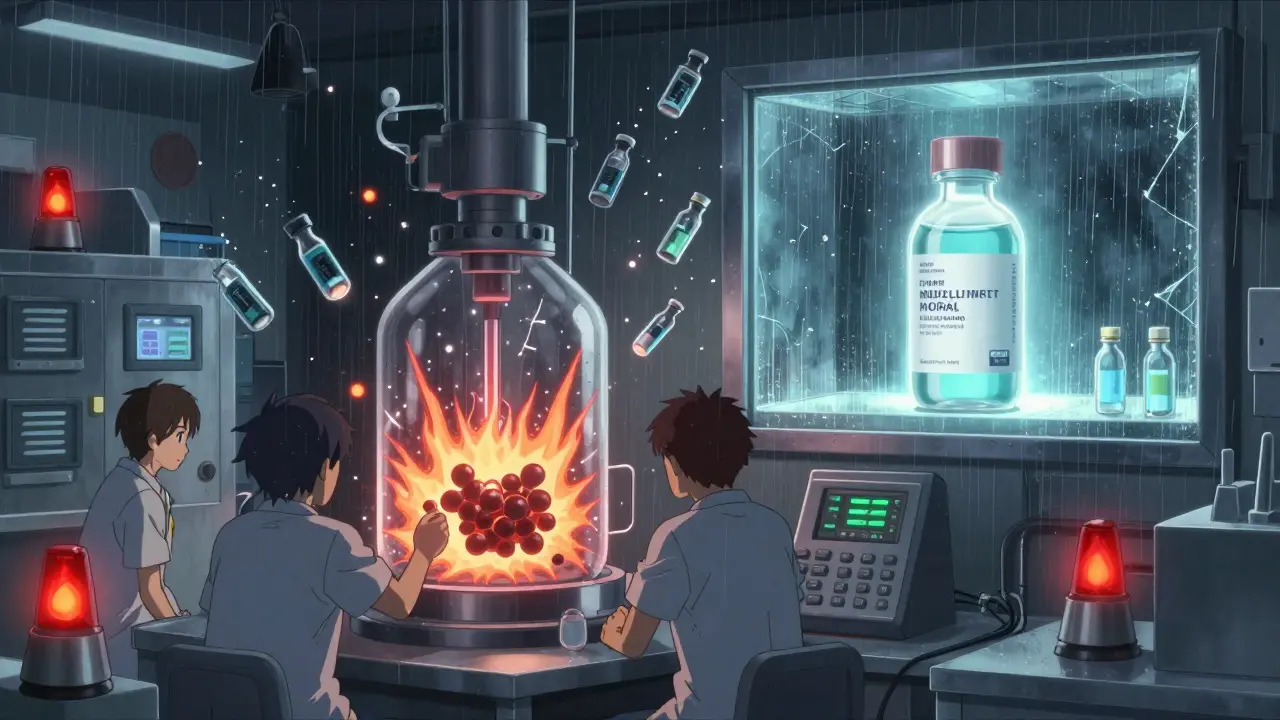
Even if you crack the formulation, you still have to make it consistently - every single time. Complex generics are sensitive. Temperature. Humidity. Light. Even the type of container matters. A cream stored in a plastic tube might degrade faster than one in a glass jar. A nanoparticle suspension might clump if shaken too hard during shipping.
Manufacturing a complex generic isn’t like making aspirin. It’s like brewing a fine wine. Small changes create big differences. A 2020 survey of generic manufacturers found that 76% listed stability testing as a top challenge. Why? Because complex products degrade in unpredictable ways. Oxidation. Hydrolysis. Phase separation. These aren’t just lab problems. They’re real-world risks that can make a batch unsafe or ineffective.
And the more ingredients a product has, the worse it gets. Products with over 10 components are exponentially harder to characterize. A single inhaler can contain the active drug, propellant, surfactant, stabilizer, and flavoring - each with its own interaction profile. One minor shift in any one of them can throw off the whole system.
Why Approval Rates Are So Low
Here’s the brutal math: For simple generics, approval rates are over 80%. For complex ones? It’s 10-15%. Why? Because 70% of applications fail at the bioequivalence stage. Most fail because:
- The testing method doesn’t match the drug’s delivery mechanism.
- The generic performs differently under real-world conditions (like high humidity or temperature swings).
- Manufacturing variability leads to inconsistent batches.
- Regulatory agencies demand different evidence.
Developing a complex generic takes 18-24 months longer than a traditional one. Costs are 2.5 to 3 times higher. And the failure rate? It’s brutal. Many companies simply walk away. That’s why there are still about 400 complex brand drugs with no generic alternative - even though they’ve been on the market for years. The science hasn’t caught up.
What’s Changing? New Tools and New Hope
The FDA isn’t ignoring this. They’ve launched the Complex Generic Drug Product Development Program. They’ve published 15 new guidance documents since 2022, covering everything from topical corticosteroids to inhaled budesonide. They’re investing in new tools:
- Physiologically-based pharmacokinetic (PBPK) modeling: Computer simulations that predict how a drug behaves in the body based on its physical properties. This could cut bioequivalence testing needs by 40-60% for some products.
- In vitro lung deposition models: Devices that mimic how particles settle in the airways - replacing human trials with lab tests.
- Advanced imaging: Technologies like confocal microscopy to track how creams penetrate skin layer by layer.
- Standardized analytical protocols: The Center for Research on Complex Generics (CRCG) has published 12 new testing methods for liposomes, nanosuspensions, and inhalers since 2022.
Companies that engage early with the FDA - before spending millions - have a 35% higher approval rate. That’s the new playbook: collaborate early, test early, and build quality into the design from day one. Quality by Design (QbD) is no longer optional. It’s mandatory.
The Future: A $45 Billion Opportunity
Despite the hurdles, the market is pushing forward. Complex generics represent a $120 billion opportunity in the U.S. alone. Sales are projected to hit $45 billion by 2028 - growing at 24.6% per year. Why? Because the drugs they replace are expensive. A single course of a branded complex inhaler can cost $5,000. A generic version? It could drop to $500. That’s not just savings. It’s access.
Regulators are starting to harmonize. The ICH is finalizing new guidelines on elemental impurities in complex formulations by late 2024. That’s one less barrier to global approval. And as tools improve, the approval window will shrink. What took 5 years might take 2.5. What took 100 test batches might take 30.
But the truth remains: complex generics aren’t easy. They’re not just "copies." They’re scientific breakthroughs in disguise. And until we can measure what happens at the site of action - not just in the blood - they’ll remain rare. But they’re coming. And when they do, they’ll change how we treat chronic disease, asthma, eczema, and more - for the better.
Releted Post

Caspian Fothergill
Hello, my name is Caspian Fothergill. I am a pharmaceutical expert with years of experience in the industry. My passion for understanding the intricacies of medication and their effects on various diseases has led me to write extensively on the subject. I strive to help people better understand their medications and how they work to improve overall health. Sharing my knowledge and expertise through writing allows me to make a positive impact on the lives of others.
This is why we can't have nice things. You can't just copy a pill like it's a DVD. These complex drugs are like quantum mechanics in a syringe. One tiny tweak and the whole thing falls apart. And don't even get me started on how the FDA and EMA don't speak the same language. We're stuck in regulatory purgatory while people suffer.
I read this and just... sat there. It's heartbreaking. We're talking about people who need these drugs to breathe, to manage pain, to live. And instead of fixing the system, we make them wait years. The science is there. The will isn't. It's not about money. It's about who we are as a society.
Let me guess... Big Pharma paid the FDA to make this hard on generics so they can keep charging $5k for inhalers. They don't want competition. They want you to believe it's 'too complex' to copy. Meanwhile, their R&D budget is bigger than some countries' GDP. This isn't science. It's a racket.
I work in pharma logistics. I've seen these creams and inhalers shipped. One time, a whole batch got stuck in a warehouse in Texas for 3 days during a heatwave. When it arrived, the nanoparticles had clumped. The whole thing was unusable. This isn't just about testing. It's about supply chains that weren't built for this kind of fragility.
We're letting foreign labs dictate our medicine standards. Why should China or India get to decide what counts as 'bioequivalent'? We invented modern medicine. Now we're begging for approval from regulators who don't even understand how these drugs work. We need American-made standards. American testing. American control.
I can't believe we're still letting people get away with this. You think it's okay to sell a cream that might not work? That's not healthcare. That's negligence. If your kid has eczema and the generic doesn't work, you're not just wasting money. You're risking their skin, their sleep, their mental health. This needs to be a criminal offense.
why do we even have this problem? if the drug works in the blood for the brand name why cant it work for the generic? its all the same chemestry right? i mean i get it if its like a rocket but its a cream or an inhaler. its not magic. why is this so hard??
I just want to say I'm so proud of our FDA for finally getting this right. 🙌 We're not just making pills anymore. We're building science. And if it takes 5 years and $10M? Worth it. My asthma inhaler saved my life. I'd rather wait than get a cheap knockoff that kills me. 💪
They're hiding the real reason. The active ingredients are laced with tracking chips. That's why they won't let generics replicate them. The nanoparticles? They're nano-transmitters. The FDA knows. The WHO knows. But they won't tell you. Why? Because they're monitoring your health data. And you're paying for it. Every time you buy a 'generic' you're signing a data contract.
I'm from the Philippines and we don't even have access to 70% of these complex generics. We're stuck with overpriced brands or nothing. The FDA's new tools? Amazing. But they're useless if they're not global. Can we get a WHO task force? Because this isn't just an American problem. It's a human problem.
I think we're overcomplicating this. Like, maybe the answer isn't more testing. Maybe it's more trust. If the brand-name drug works, and the generic looks the same, feels the same, and has the same ingredients... maybe we just let it go. We're so scared of being wrong that we're denying people medicine. Sometimes, good enough is enough.